
Quick Answer: The next generation of water heater controls relies on direct smart home integration, replacing static timers with reactive, data-driven systems. For engineers and developers, this means specifying hardware built on native IoT protocols such as Wi-Fi and Bluetooth. These units communicate directly with home energy management ecosystems, dynamically adjusting power consumption based on sensor inputs and actual usage patterns to minimize waste.
The Shift from Static Hardware to Reactive Controls
Water heating controls in residential and commercial buildings are undergoing a practical shift. For decades, system control relied on mechanical dials and basic 24-hour timers. While these legacy components were mechanically durable, they offered low energy efficiency and no adaptability to fluctuating demand. Modern building energy codes now require precise power modulation. In real-world projects, connecting legacy resistance heaters to smart home systems often requires awkward third-party relays. Specifying units with native IoT communication ensures seamless integration and reliable data exchange across the home ecosystem.
Three Technical Flaws in Legacy Heating Controls
Traditional non-smart water heating systems present clear engineering limitations under modern operating conditions.
1. Inefficient Standby Losses
Conventional storage tank water heaters suffer from continuous thermal standby loss. By maintaining 150 to 300 liters of water at elevated temperatures around the clock, these units consume energy regardless of actual occupant demand. This constant thermal dissipation increases utility costs and adds unnecessary baseload to the local power grid. Modern control boards resolve this by using logic-based heating schedules.
2. Slow Thermal Recovery Time
When peak water demand exceeds storage capacity, low-kW tank systems deplete rapidly. The time required to reheat the full volume of water is substantial, often leading to temporary hot water outages during high-use periods. From an application engineering standpoint, relying on static tank capacity without dynamic power adjustment limits system performance.
3. Single-Point Safety Failures
Legacy control systems rely primarily on mechanical snap-action thermostats to regulate water temperature. When these mechanical components fail due to contact wear or scale accumulation, they risk overheating or scalding scenarios. Modern electronic controllers integrate multiple sensor redundancies and self-diagnostics. Implementing recognized IoT security standards ensures both the physical hardware and the control network remain reliable.
The Core Technical Logic: Direct Communication
A truly integrated water heater does not rely on external control boxes; it communicates directly with the primary building automation network.
The Shift to Native Protocols
Native protocol support is essential for minimizing system latency and installation complexity. Modern water heaters should support standard wireless protocols like Wi-Fi, Zigbee, or Bluetooth directly on the main circuit board. This enables direct communication with local hubs and cloud APIs for voice control via platforms like Google Home or Alexa. At JNOD, we design our control hardware with built-in cloud connectivity to support direct integration without proprietary gateways.
How It Works: Sensor to Action
In an integrated home system, the water heater responds dynamically to automation triggers. For example, when a smart home system transitions to a “Morning Scene” via motion detection, a signal is routed to the water heater controller. The unit activates its heating elements immediately, preparing the exact required volume and temperature of water. This reactive operation minimizes idle heating time and optimizes electrical draw.
Advanced Feature Spotlight: Touchless & Precise Control
Operating electronic controls inside wet shower zones presents ongoing maintenance challenges. Physical knobs and touchscreens degrade quickly when exposed to continuous steam and wet hands, leading to seal failures and frequent service calls.
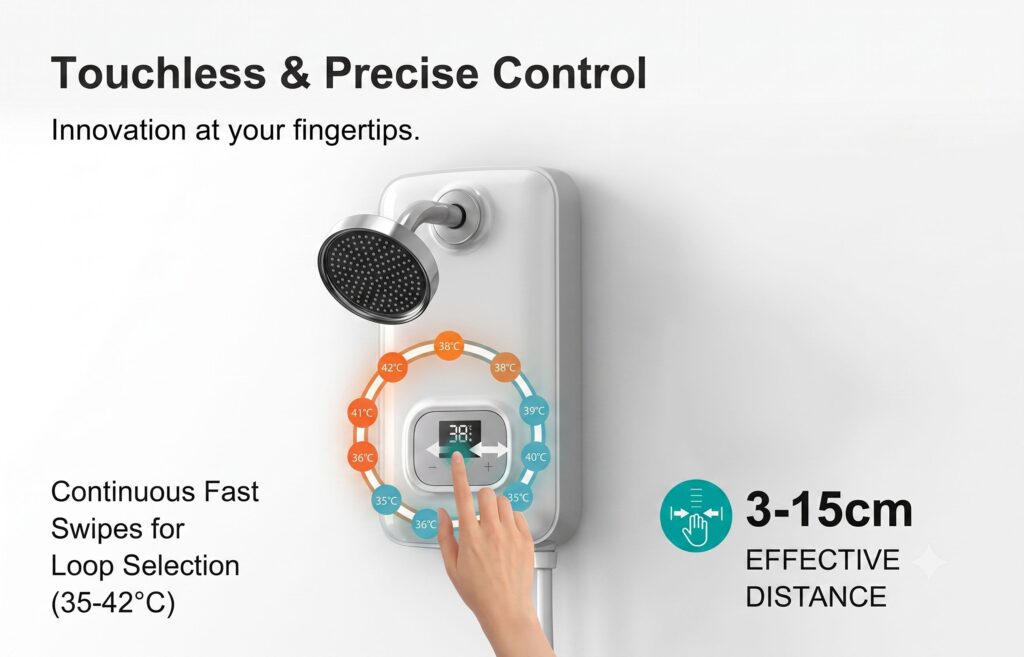
The Problem: Wet-Zone Interface Failure
In residential plumbing design, bathrooms are classified as high-moisture environments. Traditional mechanical buttons and rubber-sealed capacitive touchpads suffer from water ingress over time. As moisture penetrates the control housing, internal circuit traces corrode, resulting in unresponsive interfaces and elevated warranty claims for developers.
The Solution: 3–15cm Touchless Detection
To resolve this hardware vulnerability, our engineering team developed a touchless gesture control system for the JNOD QH Smart Instant Electric Shower Heater. Using an infrared sensor module with a 3–15 cm effective detection window, users adjust temperature settings from 35°C to 42°C with simple hand gestures. Removing physical buttons from the front panel eliminates a primary water ingress point, protecting internal electronics while maintaining hygienic operation in shared spaces.
Technical Comparison of Control Architectures
| Control Type | Data Exchange Protocol | Technical Logic | User Interface | Safety Layer |
| Traditional Mechanical | None | Binary (On/Off) | Manual Dial | Fixed Mechanical Cutout |
| Basic Digital Timer | None | Time-Based On/Off | Segment Display | Fixed Mechanical Cutout |
| Wi-Fi App Connected | Proprietary Cloud API | Remote On/Off & Scheduling | Mobile App | Local Electronic Sensor |
| Native Smart Integrated | Wi-Fi / Bluetooth / Matter | Reactive & Scene-Based | Touchless / App / Voice | Multi-Sensor Logic Redundancy |
Conclusion: The Integrated Future
The transition toward communicative water heating hardware is driven by building energy standards and occupant expectations. Legacy mechanical controllers no longer meet modern efficiency or reliability requirements. By integrating native IoT communication and touchless control interfaces, systems like the JNOD QH series eliminate common mechanical failure points while simplifying integration into broader building automation networks. Specifying natively connected hardware is a practical step toward long-term system performance and reduced maintenance overhead.
FAQ
What are the main benefits of integrating water heaters into smart home networks?
The primary technical advantage is automated load management. Integrated systems communicate with home energy monitors to avoid running during peak electrical tariff periods. Additionally, connected control boards offer remote telemetry, sending diagnostic fault codes directly to property managers before a complete system failure occurs.
Can legacy electric water heaters be retrofitted with smart home controllers?
While external smart relays can switch power on and off, they cannot provide true variable power modulation or read internal temperature sensors. Retrofitting legacy tanks with external smart plugs creates a hybrid setup with limited functionality. Specifying natively smart units from the design phase ensures reliable multi-sensor control and proper safety shut-off capabilities.
How do touchless controls improve safety in electric shower installations?
Touchless gesture interfaces eliminate physical openings on the front panel of the heater. In our smart electric shower units, the fully sealed front enclosure prevents steam and water spray from reaching internal high-voltage electronics. This design works alongside built-in Earth Leakage Circuit Breakers (ELCB) to minimize electrical hazard risks in wet environments.
Integrate Smart Controls Today
Upgrade your next residential or commercial project with natively integrated water heating controls. Replacing outdated mechanical systems with connected, touchless hardware improves building energy ratings and lowers long-term maintenance costs.
Contact JNOD’s Technical Application Team to request engineering specifications, wiring diagrams, or OEM integration details for your upcoming project.
 English
  Arabic
  Russian
  Spanish