
A 3-phase instant electric water heater can be a practical solution for commercial buildings with higher hot water demand. Hotels, apartments, restaurants, offices, and other facilities may need hot water at several outlets at the same time.
Compared with a typical single-phase unit, a three-phase system can support higher heating power when the building has a suitable three-phase electrical supply. It heats water as it flows through the heater, so there is no need for a large storage tank.
But choosing a three-phase water heater is not simply about selecting the highest kW rating. Flow rate, inlet water temperature, required outlet temperature, peak demand, and the site’s electrical supply all affect the right system.

Quick Answer
A 3-phase instant electric water heater uses three-phase electricity to heat water on demand. It is mainly suitable for commercial or multi-point applications that require higher heating power.
Typical applications include hotels, apartment buildings, restaurants, offices, commercial facilities, and projects with several simultaneous showers or washbasins.
JNOD’s three-phase models are available in 400V 3~ and 9–24 kW configurations, with applications listed for bathrooms, kitchens, hotels, commercial buildings, apartments, and shopping malls. See JNOD’s 3-phase instant water heater range.
The important point is simple: size the hot water demand first, then choose the power rating and electrical configuration.
What Is a 3 Phase Instant Electric Water Heater?
A three-phase instant electric water heater heats water as it passes through the heating system instead of storing a large volume of hot water in a tank.
When a hot water outlet is opened, the heater detects water flow and activates the heating system. The required electrical power then raises the water temperature as it passes through the unit.
The basic relationship is:
Heating power depends mainly on flow rate and temperature rise.
A higher flow rate requires more heating power. A greater temperature rise also requires more power.
For a commercial project, this is important because inlet water temperature can vary significantly between locations and seasons. A system that works well when incoming water is warm may need much more power when the water temperature drops.
JNOD’s instant electric water heaters cover different configurations for shower, kitchen, point-of-use, and multi-point applications.
Why Use a 3 Phase Electric Water Heater?
The main reason is higher available heating capacity.
Electric water heating is a high-power application. As flow rate and temperature rise increase, the electrical input required by the heater also increases.
Three-phase power allows the load to be distributed across three phases. This makes higher-power electric heating more practical when the building already has a suitable three-phase electrical supply.
For example, a small point-of-use heater may work well with a lower-power single-phase supply. A hotel shower system with several outlets operating at the same time may require considerably more power.
Three-phase is therefore not automatically better. It is useful when the heating load and electrical infrastructure justify it.
The U.S. Department of Energy recognizes commercial instantaneous water heaters as a distinct category of commercial water-heating equipment, alongside storage water heaters and hot water supply boilers.
When Does a Commercial Project Need a 3 Phase Water Heater?
Three-phase equipment becomes more relevant as the hot water load increases.
Multiple hot water outlets
A hotel may have several showers operating during the same period. A restaurant may need hot water in the kitchen while handwashing stations are also in use.
The system should therefore be sized around realistic peak demand rather than average daily consumption.
Higher flow rates
Flow rate has a direct effect on required heating power.
A shower operating at 8 L/min requires more heating power than a washbasin operating at 4 L/min when both have the same temperature rise.
For multiple outlets, the designer should estimate the combined flow that may occur at the same time.
Larger temperature rise
Temperature rise is the difference between the inlet and outlet water temperatures.
For example:
Inlet water: 15°C
Required outlet: 45°C
The required temperature rise is:
45°C − 15°C = 30°C
If the inlet water drops to 5°C, the temperature rise becomes 40°C. The required heating capacity increases even though the target outlet temperature has not changed.
Limited installation space
Storage tanks can take up significant space in commercial buildings.
A tankless system can be mounted closer to the point of use or connected to multiple hot water outlets, depending on the system design. JNOD’s three-phase models are wall-mounted and are listed for point-of-use and multi-point applications.
How to Choose the Right kW for a 3 Phase Water Heater?
The correct power rating depends primarily on flow rate and temperature rise.
A useful calculation for water heating is:
Power (kW) ≈ Flow Rate (L/min) × 0.0698 × Temperature Rise (°C)
For example, suppose a commercial shower application requires:
| Parameter | Example |
|---|---|
| Flow rate | 8 L/min |
| Inlet water temperature | 15°C |
| Outlet water temperature | 45°C |
| Temperature rise | 30°C |
The approximate heating power is:
8 × 0.0698 × 30 ≈ 16.8 kW
An 18 kW heater could therefore be considered as a starting point for this example.
This does not mean every 8 L/min application needs an 18 kW unit. Final selection should also consider simultaneous demand, water pressure, flow variation, electrical capacity, pipe conditions, and the actual operating environment.
JNOD has already published a detailed guide to choosing the right kW for an instant electric water heater, which explains the relationship between flow rate, temperature rise, and heating power.
Single Phase vs Three Phase Water Heaters
The choice between single-phase and three-phase should be based on the actual project load.
| Factor | Single Phase | Three Phase |
|---|---|---|
| Typical application | Smaller loads | Higher-power applications |
| Suitable for | Single-point or smaller systems | Commercial and multi-point systems |
| Electrical supply | Single phase | Three phase |
| Higher heating capacity | More limited | More suitable |
| Typical project examples | Small shower, sink | Hotel, apartment, commercial facility |
| Main consideration | Available current | Available three-phase capacity |
A three-phase water heater should not be selected simply because a project is commercial.
A small office with one washbasin may not need one. A hotel with several simultaneous showers may need substantially more heating capacity.
The electrical supply must also be checked before ordering. Voltage, phase, frequency, breaker capacity, cable requirements, and local regulations all need to match the selected model.
What Flow Rate Should You Check?
Flow rate is one of the most important parameters in tankless water heating.
Before choosing a heater, determine:
- The expected flow rate at each outlet
- Which outlets may operate at the same time
- The lowest realistic inlet water temperature
- The required outlet temperature
For example, three showers operating at 6 L/min each create a combined demand of approximately 18 L/min.
That is very different from sizing a heater for one 6 L/min shower.
This is why a commercial water heater should be sized from actual peak water demand, not simply from the number of rooms, bathrooms, or users.
What to Look for in a Commercial Water Heater
Heating power is important, but it is not the only purchasing consideration.
Stable temperature control
Commercial users need consistent hot water even when water conditions change.
JNOD’s three-phase models continuously monitor water temperature and flow and use electronic temperature control. The FDCHE, for example, has a listed temperature setting range of 30–60°C.
Safety protection
A commercial electric water heater should have appropriate protection for both electrical and water-related risks.
JNOD’s listed three-phase models include protection against overheating, electrical leakage, over-pressure, and scalding. The models also list IP25 protection and CE, CB, LVD, and EMC certifications.
For instantaneous water heaters, IEC 60335-2-35 is the relevant IEC safety standard for household and similar-use instantaneous water heaters. See the official IEC 60335-2-35 standard for the applicable safety requirements.
Compact installation
Commercial projects often have limited equipment space.
A tankless unit avoids the need for a large storage tank and can be installed on a wall or closer to the point of use, depending on the design.
Service and documentation
For B2B buyers, long-term support matters.
Before ordering, it is worth checking:
- Product specifications
- Installation instructions
- Spare parts
- Warranty
- Certifications
- OEM/ODM support
- Technical assistance
A heater that matches the required kW but lacks proper documentation or after-sales support can create problems after installation.
Where Can 3 Phase Instant Electric Water Heaters Be Used?
Hotels
Hotels may have high peak hot water demand in guest bathrooms and service areas.
Three-phase instant water heaters can be considered where the project requires higher heating capacity and the building has a suitable electrical supply.
Apartments
Apartment projects require careful planning because several hot water points may operate at the same time.
For distributed applications, point-of-use systems may simplify the installation. Larger multi-point systems require a calculation based on peak simultaneous flow.
Restaurants
Restaurants need hot water for kitchen operations, cleaning, and handwashing.
Demand can change considerably throughout the day, so the system should be selected according to the expected peak load rather than average usage.
Offices and Commercial Facilities
Offices, shopping centers, service facilities, and similar buildings may need several hot water points while having limited installation space.
A higher-power three-phase system can be useful where the available electrical infrastructure and actual hot water demand support it.
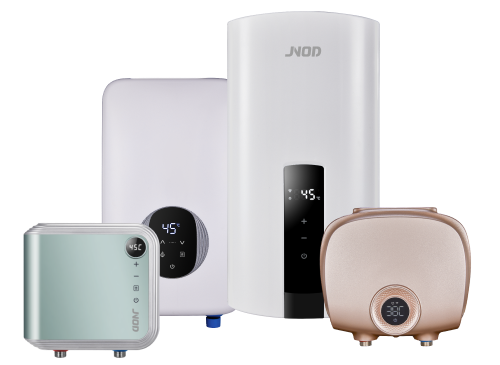
JNOD 3 Phase Instant Electric Water Heater Range
JNOD offers several three-phase models for different applications.
| Model | Voltage | Power | Main Features |
|---|---|---|---|
| FDCHE | 400V 3~ | 9–24 kW | Touch control, remote control |
| FM | 400V 3~ | 9–24 kW | Touch screen, optional Wi-Fi |
| FM-Z | 400V 3~ | 9–24 kW | Built-in DC pump, zero-cold-water function |
| JNE | 400V 3~ | 9–24 kW | Touch control, optional Wi-Fi |
| FSG-3 | 400V 3~ | 9–24 kW | Compact wall-mounted design |
For a standard commercial application, the JNOD FDCHE three-phase instant water heater provides 9–24 kW options at 400V 3~ and is listed for hotel, commercial, apartment, kitchen, bathroom, and shopping mall applications.
JNOD also offers the FM three-phase instant water heater with 9–24 kW options, touch control, and optional smart Wi-Fi control.
What Should Buyers Check Before Ordering?
Commercial buyers should confirm the following information before selecting a model.
Electrical supply
Confirm the site’s:
- Voltage
- Phase
- Frequency
- Available current
- Breaker capacity
- Cable requirements
Do not assume that a commercial building automatically has the correct three-phase supply.
Peak water demand
Estimate the maximum number of outlets that may operate at the same time.
This is more useful than simply counting the total number of rooms.
Inlet water temperature
Use the lowest realistic inlet temperature for the project, especially in regions with cold winters.
Outlet temperature
Define the required water temperature for the actual application.
Different applications may have different requirements.
Water pressure and flow
Check the operating pressure and expected flow against the manufacturer’s specifications.
For example, the JNOD FDCHE lists a rated pressure range of 0.02–0.6 MPa.
Local standards
Certification and installation requirements vary by market.
For projects in the United States, buyers should check the applicable DOE requirements for the relevant commercial water-heating equipment. DOE maintains current information on commercial water-heating standards and test procedures.
For other markets, the applicable electrical, safety, efficiency, and installation requirements should be confirmed before ordering.
FAQ
It is a tankless electric water heater that uses three-phase electrical power to heat water as it flows through the unit. It is typically used for higher-power or multi-point hot water applications.
It depends on the required flow rate and temperature rise.
For example, 8 L/min with a 30°C temperature rise requires about 16.8 kW of heating power under ideal conditions. The actual heater size should also consider peak demand, flow variation, and the available power ratings.
Yes, but the required capacity depends on the combined flow rate and temperature rise.
Three 6 L/min showers, for example, create a combined flow rate of about 18 L/min. The required heating power then depends on the inlet water temperature and target outlet temperature.
There is no single standard voltage for all three-phase instant water heaters. The required voltage depends on the model and the local electrical supply. JNOD’s listed three-phase models use 400V 3~ and are available in 9–24 kW configurations.
Not necessarily. Three-phase is more suitable when a project requires higher heating power and has a compatible three-phase electrical supply. Smaller point-of-use applications may be better suited to single-phase equipment.
No. An instant electric water heater heats water as it passes through the heater instead of storing a large volume of hot water
For a commercial project, provide the application, number of hot water outlets, expected simultaneous flow, inlet water temperature, target outlet temperature, water pressure, and electrical supply.
These details allow the manufacturer to recommend a more appropriate power rating and configuration.
Conclusion
A 3-phase instant electric water heater can be a practical choice for commercial projects that need higher heating capacity, compact installation, or hot water at multiple points.
The right model should not be selected by kW alone. Flow rate, temperature rise, peak demand, inlet water temperature, water pressure, and electrical supply all affect the result.
JNOD offers 400V 3~ instant electric water heaters from 9 to 24 kW for applications including hotels, apartments, commercial buildings, kitchens, bathrooms, and other multi-point hot water systems.
Need a Three-Phase Water Heater for Your Project?
Send JNOD your application, number of hot water points, expected flow rate, inlet water temperature, required outlet temperature, and electrical supply.
Our team can help you identify a suitable power range and product configuration for your project.
 English
  Arabic
  Russian
  Spanish