
An OEM electric water heater project involves more than adding a logo to an existing product. For wholesalers, importers, and private-label brands, decisions made before production can affect product performance, compliance, cost, and delivery.
Two water heaters may look identical but have different voltage ratings, heating elements, or control systems. Overlooking these differences can lead to sample revisions, compliance issues, or production delays.
To avoid such problems, buyers should agree on the technical specifications, customization requirements, compliance responsibilities, and final sample before mass production begins.
This guide explains what to check and how to prepare an OEM electric water heater order for production.
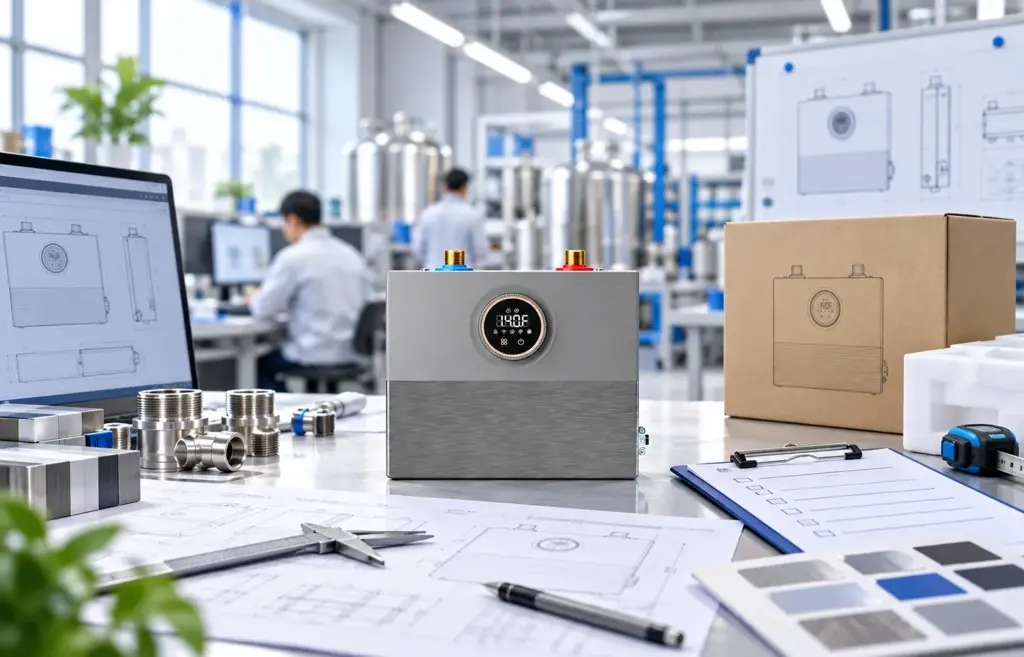
Quick Answer: What Should Buyers Check Before OEM Production?
Before manufacturing an OEM electric water heater, buyers should confirm the target market, electrical specifications, heating performance, customization requirements, compliance documents, sample approval, and production arrangements.
| Item | What Buyers Should Confirm |
|---|---|
| Target market | Destination country and local requirements |
| Electrical specifications | Voltage, frequency, phase, and rated power |
| Heating performance | Flow rate, temperature rise, and controls |
| Customization | Branding, housing, display, and functions |
| Compliance | Applicable standards and documentation |
| Sample approval | Appearance, performance, and safety requirements |
| Packaging | Labels, manuals, cartons, and accessories |
| Production | Final specifications, inspections, and delivery terms |
The objective is simple: both parties should approve the same product configuration before production starts.
1. Define the Target Market First
The destination market should be one of the first details discussed with an electric water heater manufacturer.
Electrical supplies, installation practices, and product requirements vary between countries. A model suitable for one region may need changes before entering another market.
Before requesting a quotation, confirm:
- Destination country or region
- Local voltage, frequency, and phase
- Applicable safety and compliance requirements
- Required instruction languages
- Intended application and installation conditions
For example, an OEM buyer targeting Europe may need a different electrical configuration and compliance package from one targeting North America.
If you plan to distribute the same product across several countries, discuss these differences early. One configuration may not meet every market’s requirements.
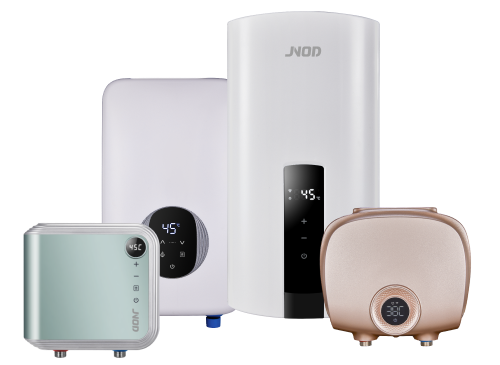
JNOD’s electric water heater range includes products for shower, kitchen, residential, and commercial applications, with OEM and ODM cooperation options for wholesale buyers and brand owners.
2. Confirm Electrical and Heating Specifications
Once the target market is clear, define the technical requirements. For instantaneous electric water heaters, electrical capacity and hot water demand must be considered together.
Voltage, Phase, and Power
Buyers should specify the rated voltage, frequency, phase, and required heating power.
For example, JNOD’s FDCHE three-phase instant electric water heater offers standard power options of 9, 12, 15, 18, 21, and 24 kW at 400V 3~.
The product also offers different housing colors and touch-screen or remote-control options.
For an OEM project based on this series, buyers should confirm the selected power rating, control functions, appearance, and compliance documentation before approving the sample.
However, published product options do not mean every requested electrical modification is available. The manufacturer must confirm the feasibility of any non-standard configuration.
Flow Rate and Temperature Rise
Heating power alone does not tell buyers how much hot water a unit can deliver.
For example, a buyer may request 8 L/min at an outlet temperature of 45°C. The required heating power depends on the inlet temperature.
If incoming water is 15°C, the heater must provide a 30°C temperature rise. Colder inlet water increases the power required to maintain the same flow and outlet temperature.
Therefore, specify:
- Required flow rate
- Minimum inlet water temperature
- Target outlet temperature
- Number of simultaneous outlets
- Available water pressure
These figures allow the manufacturer to assess whether the proposed heater can meet the intended operating conditions.
3. Decide What Needs to Be Customized
Not every OEM project requires a new product design.
Some buyers only need branded packaging and a customized front panel. Others require changes to the controls, housing, or heating system.
Common customization requests include:
- Logo, housing color, and front panel
- Display interface and control options
- Temperature settings and product functions
- Heating power configurations
- Product labels, manuals, and packaging
JNOD’s custom water heater solutions cover appearance, structural design, and functional development.
However, buyers should distinguish branding changes from technical modifications.
Changing a logo or carton design generally involves different work from modifying a heating element, PCB, or electrical system. Technical changes may affect component selection, testing, compliance, cost, and lead time.
Before confirming the quotation, ask the manufacturer which requests are feasible and whether they require additional development or validation.
4. Check Certification Before Changing the Product
Compliance is particularly important when an OEM electric water heater will be sold under the buyer’s own brand.
A manufacturer may have compliance documents for its standard product, but those documents may not automatically cover a customized version.
Changes to the rated voltage, heating element, control board, or electrical construction can affect the existing conformity assessment.
For instantaneous electric water heaters within its scope, IEC 60335-2-35 provides relevant product safety requirements.
Who Is Responsible for Compliance Under an OEM Brand?
For products entering the European Union, the company responsible for compliance may not be the factory that physically manufactures the product.
Under EU product rules, a business that has a product manufactured and markets it under its own name or trademark may be considered the manufacturer.
This means the brand owner may need to take responsibility for the applicable conformity assessment, technical documentation, and EU Declaration of Conformity.
The European Union’s CE marking guidance explains these obligations.
Before production, clarify:
- Who is legally responsible for product compliance?
- Does the documentation cover the final OEM configuration?
- Are additional assessments or tests required?
- Who prepares and maintains the technical documentation?
- Who is responsible for the required markings and declarations?
Not every customization requires all tests to be repeated. The manufacturer and relevant conformity assessment or certification body should evaluate the impact of each modification.
For a more detailed explanation, read JNOD’s electric water heater certifications guide for wholesale buyers.
5. Finalize Labels, Manuals, and Packaging
Product documentation should be approved before mass production, not left until shipment.
For private-label orders, check that the product label matches the final specifications, including the model number, electrical ratings, required warnings, and applicable conformity markings.
The instruction manual should also reflect the approved product functions and destination-market requirements.
For example, a distributor selling across several European countries may need different instruction languages.
Before approving production, confirm the final artwork for the product label, manual, carton, and packaging inserts. If the packaging itself requires a sample, review it alongside the product.
6. Approve the Sample Before Mass Production
Sample approval gives buyers and manufacturers a common reference for the final product.
The sample should reflect the agreed specifications, functions, and appearance rather than merely resemble the standard model.
What Should Buyers Check?
| Sample Check | What to Verify |
|---|---|
| Appearance | Housing, logo, color, and finish |
| Electrical rating | Voltage, frequency, phase, and power |
| Heating performance | Flow rate and outlet temperature under agreed conditions |
| Controls | Display, settings, buttons, and optional functions |
| Safety | Required protection functions and relevant test results |
| Installation | Dimensions, connections, and accessories |
| Documentation | Labels, manual, and packaging artwork |
For heating performance, record the test conditions.
Simply checking whether the product produces hot water is not enough. Both parties should agree on the inlet temperature, flow rate, and expected outlet temperature, then compare the test results with those requirements.
Keep an Approved Reference Sample
Once the sample meets the agreed specifications, retain a final reference version.
The approval record should include the technical specification, product configuration, artwork, relevant test results, and sample approval date.
This reference sample, sometimes called a golden sample, helps both parties check whether production units match the approved product.
Any subsequent design change should be documented and reviewed before production continues.
7. Confirm Quality Control Requirements
A good sample establishes the expected product standard. Quality control helps maintain that standard throughout production.
Before placing a bulk order, buyers should understand how the factory inspects materials, monitors assembly, and tests finished products.
JNOD’s published quality assurance process includes four stages:
- IQC (Incoming Quality Control): Checks incoming components and materials.
- IPQC (In-Process Quality Control): Monitors quality during manufacturing.
- FQC (Finished Quality Control): Inspects and tests completed products.
- OQC (Outgoing Quality Control): Checks products before shipment.
For a particular OEM model, buyers should confirm which tests and inspections apply.
Useful questions include whether the factory performs functional testing, how it handles nonconforming units, what inspection records are available, and how production batches can be traced.
The inspection requirements and acceptance criteria should be agreed upon before manufacturing begins.
8. Freeze the Specifications Before Production
After sample approval, the buyer and manufacturer should agree on the final product configuration.
This step is often called a specification freeze. It prevents confusion between an early quotation, a revised sample, and the actual production order.
The final approval package should include:
| Document | What It Confirms |
|---|---|
| Technical specification | Model, electrical ratings, performance, and functions |
| Approved sample | Final product reference |
| Artwork files | Logo, labels, front panel, and packaging |
| Compliance documentation | Requirements for the final configuration |
| Purchase order | Quantity, pricing, and commercial terms |
| Production schedule | Agreed milestones and delivery plan |
| Quality requirements | Inspection methods and acceptance criteria |
Also confirm the MOQ, any development or tooling charges, warranty terms, spare parts arrangements, and additional testing costs where applicable.
If a critical specification changes after approval, both parties should review its impact on product performance, compliance, cost, and delivery.
Typical OEM Production Process
Market Requirements → Product Specifications → Customization Review → Sample Testing → Sample Approval → Specification Freeze → Mass Production → Final Inspection
This is a useful framework for managing an OEM project. The exact process should be agreed with the manufacturer according to the order’s requirements.
9. What to Include in an OEM Electric Water Heater RFQ
A clear Request for Quotation (RFQ) helps the manufacturer understand your project and recommend suitable product configurations.
Instead of asking only for an OEM price, provide the following information:
| RFQ Field | Information to Provide |
|---|---|
| Company / Brand | Company name and intended brand |
| Target Market | Destination country or region |
| Product Type | Shower, kitchen, under-sink, or commercial |
| Electrical Requirements | Voltage, frequency, phase, and preferred kW |
| Hot Water Demand | Flow rate, inlet temperature, and outlet temperature |
| Customization | Logo, housing, controls, and packaging |
| Compliance | Applicable market requirements |
| Order Quantity | Initial order and estimated annual volume |
| Project Schedule | Expected sample and delivery dates |
Example OEM Inquiry
We are looking for an OEM instant electric water heater for distribution in Europe. We require a 400V three-phase model with several power options, customized branding, and packaging under our company name.
Please advise on suitable models, applicable compliance documentation, MOQ, sample requirements, and estimated production lead time.
This gives the manufacturer enough information for an initial discussion without requiring every detail to be finalized immediately.
FAQ
An OEM electric water heater is manufactured according to agreed buyer specifications or branding requirements. It may use an existing product platform or include approved technical and design modifications.
Possibly. The manufacturer must first confirm technical feasibility. Such changes may affect components, safety testing, compliance documentation, and production cost.
It can. Changes to electrical components, controls, heating elements, or product construction may require additional assessment. Buyers should confirm whether existing documentation covers the final configuration.
Yes. An approved sample provides a reference for appearance, functions, specifications, and performance. The manufacturer and buyer should record the accepted configuration and use it during production and inspection.
Confirm the final specifications, sample approval, compliance responsibilities, packaging, order quantity, pricing, production schedule, inspection requirements, and after-sales terms.
Conclusion
A successful OEM electric water heater project starts with clear technical and commercial requirements.
Before mass production, wholesale buyers should confirm the destination market, electrical specifications, heating performance, customization details, compliance responsibilities, and an approved sample.
Once both parties agree on the final configuration and production requirements, they have a clearer basis for manufacturing, inspection, and delivery.
Planning an OEM Electric Water Heater Project?
JNOD works with distributors, importers, wholesalers, and brand owners on OEM and ODM electric water heater solutions.
Share your target market, product requirements, customization needs, and estimated order quantity. Our team can review suitable product options and discuss the next steps.
 English
  Arabic
  Russian
  Spanish