
For wholesalers and distributors, selling electric water heaters is only part of the business. Reliable after-sales service also depends on having the right electric water heater spare parts available when repairs are needed.
A missing flow sensor or control board can delay a repair, while stocking every possible component creates unnecessary costs. Distributors need to balance service readiness with inventory investment.
This guide explains which replacement parts to consider, how to check compatibility, and how to plan spare parts inventory for the water heater models you sell.
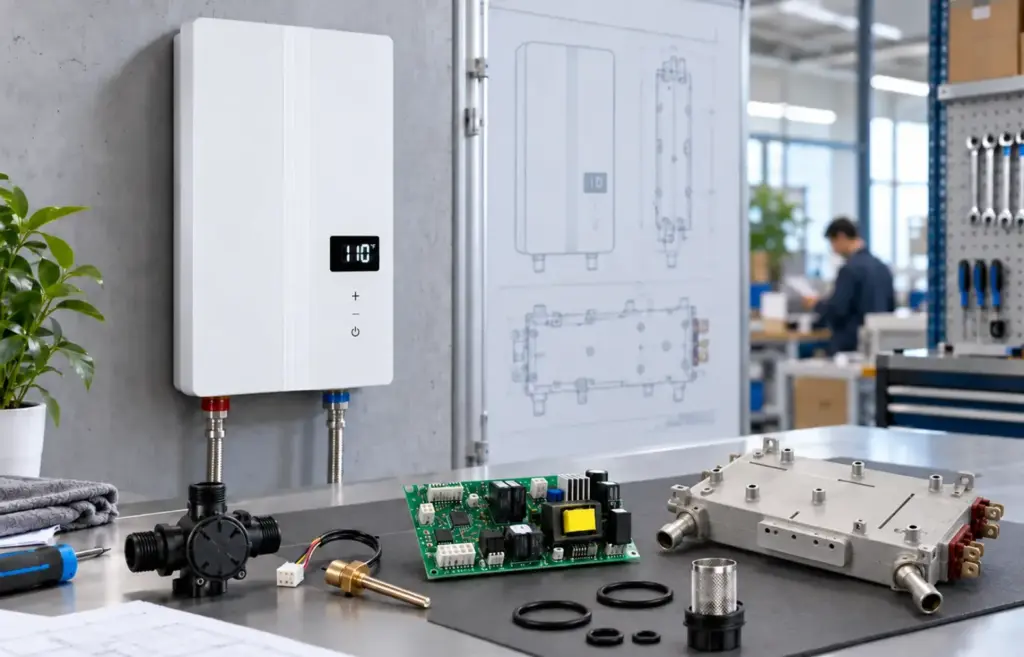
Quick Answer: Which Electric Water Heater Spare Parts Should Distributors Stock?
For tankless electric water heaters, distributors should evaluate inlet filters, approved seals, flow sensors, temperature sensors, heating assemblies, control boards, and display components.
However, the right inventory depends on the models sold, service records, part availability, and supplier lead times.
| Spare Part | Main Function | Stocking Consideration |
|---|---|---|
| Inlet filter or screen | Keeps debris from entering the unit | Consider regular service stock |
| Seals and O-rings | Maintain watertight connections | Stock approved model-specific kits |
| Flow sensor or switch | Detects water demand | Consider for high-volume models |
| Temperature sensor | Monitors water temperature | Stock based on service history |
| Heating element | Heats flowing water | Assess replacement cost and lead time |
| PCB or control board | Manages heating and protection functions | Prioritize compatibility |
| Display or control panel | Provides user controls and status information | Consider demand and model variations |
Important: Not every component is available as an individual spare part. Some water heaters require complete assembly replacement or factory-authorized servicing. Always confirm approved parts and serviceability with the manufacturer.
1. Why Spare Parts Matter to Distributors
When a customer reports a water heater problem, the distributor is often the first point of contact.
Whether the issue involves unstable temperature, poor water flow, or a control malfunction, resolving it requires accurate diagnosis, suitable replacement parts, and qualified technicians.
Without an organized spare parts process, distributors may face:
- Longer repair times and higher emergency shipping costs
- Delayed warranty claims
- Unnecessary replacement of complete units
- Repeated communication to identify compatible components
For distributors managing a large installed base, these problems can affect customer satisfaction and after-sales costs.
The goal is not to stock everything. It is to keep the parts that matter most readily available.
2. Common Electric Water Heater Replacement Parts
Instant electric water heaters contain electrical and water-related components, but their construction varies by model.
JNOD’s guide to the main parts of a water heater explains their functions. For distributors, the priority is understanding which components can be serviced and how to order the correct replacements.
Flow Sensors and Flow Switches
Flow sensors or switches help the control system detect water demand and activate heating.
When a heater fails to start, the problem may involve flow detection. However, low water pressure or a blocked inlet screen can produce similar symptoms.
Technicians should follow the manufacturer’s diagnostic procedures before replacing a sensor.
Heating Elements and Heating Assemblies
Heating elements convert electrical energy into heat.
Replacement parts may differ in voltage, power rating, dimensions, terminals, and construction. Some models use integrated heating assemblies that require complete module replacement.
Because these components can be relatively expensive, distributors should evaluate demand and replenishment lead time before keeping them in stock.
Temperature Sensors
Temperature sensors support heating control and temperature monitoring.
Although sensors may look similar, their electrical characteristics and connectors can differ. Buyers should confirm the exact part number and compatible product revision.
Control Boards and Displays
The PCB manages electronic functions, heating control, and protection systems.
Board compatibility may depend on voltage, power rating, firmware, sensor configuration, or product revision.
This is particularly important for OEM products, where a customized display or control system may require different electronics from the standard model.
Filters, Seals, and Water Connections
Inlet screens, O-rings, and gaskets are smaller components, but damaged or obstructed parts can affect water flow or cause leaks.
Distributors should confirm which items are available as approved replacements.
For components that contact potable water, buyers must also consider the destination market’s material requirements.
NSF/ANSI/CAN 61 addresses health-related requirements for certain drinking-water system components, particularly in North America. However, it is not a universal certification requirement for every water heater spare part.
3. Which Spare Parts Should Distributors Stock First?
Spare parts should be prioritized according to service demand, downtime risk, cost, and replenishment lead time.
A three-level approach provides a practical starting point.
| Priority | Stocking Approach | Examples to Evaluate |
|---|---|---|
| High | Keep essential service stock where justified | Approved seals, inlet screens, frequently requested sensors |
| Medium | Maintain limited quantities for supported models | Control panels and common PCB variants |
| Conditional | Order when needed or maintain a small reserve | Expensive heating assemblies and low-volume components |
These are planning examples rather than fixed rules. Actual stocking priorities should come from the distributor’s service history.
Consider Downtime, Not Just Part Cost
An expensive control board may justify local stock if its absence could leave a customer’s heater out of service for weeks.
Meanwhile, a specialized component used in only a few installations may be better ordered when required.
The key question is:
What is the cost of waiting for this part compared with the cost of keeping it in stock?
This helps distributors make purchasing decisions based on service needs rather than component price alone.
4. Check Spare Parts Compatibility Before Ordering
Two water heaters may share the same housing while using different internal components.
Before ordering replacement parts, confirm:
- Product model and serial number
- Rated voltage, phase, and heating power
- Production batch or revision
- Original spare part number
- PCB or firmware version, where applicable
- Connection type and installation dimensions
For example, a distributor selling both single-phase and three-phase tankless electric water heaters should maintain separate compatibility records.
Even within one product series, different power ratings may require different heating assemblies or control components.
Maintain a Model-to-Part Reference List
| Product Information | Required Record |
|---|---|
| Product model | Exact model designation |
| Electrical rating | Voltage, phase, and kW |
| Production version | Batch or revision code |
| Spare part | Manufacturer’s description |
| Part number | Approved replacement code |
| Compatibility | Supported models and versions |
Ask the manufacturer to update this reference whenever a component or product design changes.
For OEM and customized water heaters, maintaining accurate records is especially useful because visually identical products may contain different electronics or internal assemblies.
5. How Much Spare Parts Inventory Is Enough?
There is no universal stocking quantity for every distributor.
A practical inventory plan should consider the installed base, historical replacement demand, and supplier replenishment time.
For regularly requested parts, distributors can use a simple reorder-point calculation:
Reorder Point = Expected Demand During Lead Time + Safety Stock
Example: Setting a Reorder Point
Suppose a distributor uses an average of three replacement sensors per month.
The supplier takes two months to replenish the part, and the distributor decides to keep two additional sensors as safety stock.
| Item | Example |
|---|---|
| Average monthly demand | 3 sensors |
| Replenishment lead time | 2 months |
| Expected demand during lead time | 6 sensors |
| Safety stock | 2 sensors |
| Reorder point | 8 sensors |
In this example, the distributor should trigger replenishment when its inventory position reaches or falls below eight sensors.
Inventory position is calculated as:
Inventory Position = Stock on Hand + Outstanding Orders − Backorders
For example, if five sensors remain in stock and six more are already on order, inventory position is 11 units, assuming no backorders. Under this simplified policy, another order is not yet required.
This is an illustrative calculation, not JNOD failure-rate data or a recommended fixed stocking quantity.
For rarely needed but service-critical parts, a small emergency reserve may still be useful. Distributors should also monitor component revisions, storage conditions, and the risk of holding obsolete electronic parts.
6. Coordinate Spare Parts with Warranty and Technical Service
Having replacement parts available does not guarantee an effective repair.
Distributors also need clear warranty procedures, technical instructions, and authorization for service work.
Before placing a bulk order, confirm:
- Which parts the warranty covers
- What evidence is required for a warranty claim
- Who diagnoses faults and authorizes replacement
- Which repairs local technicians can perform
- Whether service manuals and technical training are available
- How older product revisions will be supported
Safety Comes First
Electric water heaters involve hazardous electrical voltages, hot water, and pressurized connections.
Qualified technicians must follow the manufacturer’s service instructions and applicable safety requirements.
The US Occupational Safety and Health Administration provides guidance on controlling hazardous energy during servicing and maintenance.
Before servicing a unit, technicians should follow applicable procedures to isolate electrical power and address stored energy or water pressure.
Never bypass protective devices or substitute unapproved components to restore operation.
7. How JNOD Supports Distributors
Reliable manufacturer support helps distributors manage products beyond the initial sale.
JNOD’s published quality assurance process includes incoming component inspection, in-process quality control, finished-product testing, and outgoing inspection.
JNOD also provides technical training, after-sales support, and accessories supply for distribution partners.
When discussing a new supply agreement, buyers can ask about:
- Spare parts availability for selected models
- Recommended initial service stock
- Component identification and compatibility
- Warranty procedures and technical assistance
- Replacement parts for OEM or private-label configurations
Specific parts, quantities, lead times, and warranty conditions should be confirmed for each product and purchasing agreement.
Discussing these requirements during product selection helps distributors prepare for future service needs.
8. Electric Water Heater Spare Parts Checklist for Distributors
Before confirming a supply agreement, use this checklist to evaluate spare parts support.
| Checkpoint | Question to Ask |
|---|---|
| Spare parts list | Is a model-specific parts list available? |
| Serviceability | Which components can authorized technicians replace? |
| Compatibility | Are part numbers linked to product revisions? |
| Initial stock | Which parts are recommended for local inventory? |
| Availability | Can the required parts be supplied separately? |
| Lead time | How long does replenishment normally take? |
| Warranty | What coverage and claim procedures apply? |
| Training | Are service instructions or training available? |
| Product updates | How are component changes communicated? |
| Future support | How will older models be supported? |
The answers provide a practical starting point for a spare parts plan tailored to the distributor’s product range and service responsibilities.
FAQ
For tankless models, distributors should evaluate flow sensors, temperature sensors, heating assemblies, PCBs, inlet screens, seals, and control panels. Actual stocking priorities depend on service demand, compatibility, and component availability.
A limited reserve may be worthwhile for high-volume models or components with long replenishment times. However, distributors should verify the correct board revision and firmware before ordering.
Not necessarily. Components that look similar may have different electrical ratings, connectors, dimensions, or firmware. Use manufacturer-approved replacements for the exact model and revision.
Track replacement demand, prioritize service-critical components, calculate reorder points, and avoid excessive stock of expensive or rarely used parts. Include outstanding orders and backorders when assessing inventory levels.
Conclusion
Managing electric water heater spare parts is an important part of building a reliable distribution business.
Rather than stocking every component, distributors should prioritize service demand, model compatibility, replenishment time, and manufacturer support.
A practical spare parts plan can reduce unnecessary inventory costs, support faster repairs, and improve the after-sales experience.
Looking for Electric Water Heaters with Manufacturer Support?
JNOD works with wholesalers, distributors, and brand owners on electric water heater supply and OEM/ODM projects.
Share your target market, product models, estimated order quantity, and after-sales requirements. Our team can discuss suitable products, spare parts availability, and technical support arrangements.
 English
 Arabic
 Russian
 Spanish