
When buying electric water heaters in bulk, wholesale buyers should check electric water heater certifications as carefully as price and product specifications. They also need to know whether the products meet the destination market’s requirements and whether the supplier can provide the right compliance documents.
This is where electric water heater certifications matter.
CE, CB, ETL, LVD, EMC, and RoHS often appear together in supplier catalogs. However, they do not all mean the same thing. Some refer to certification schemes or marks, while others relate to legislation, technical requirements, or supporting documents.
For a wholesale order, the practical question is:
Does the product have the right compliance documentation for my market, model, and application?
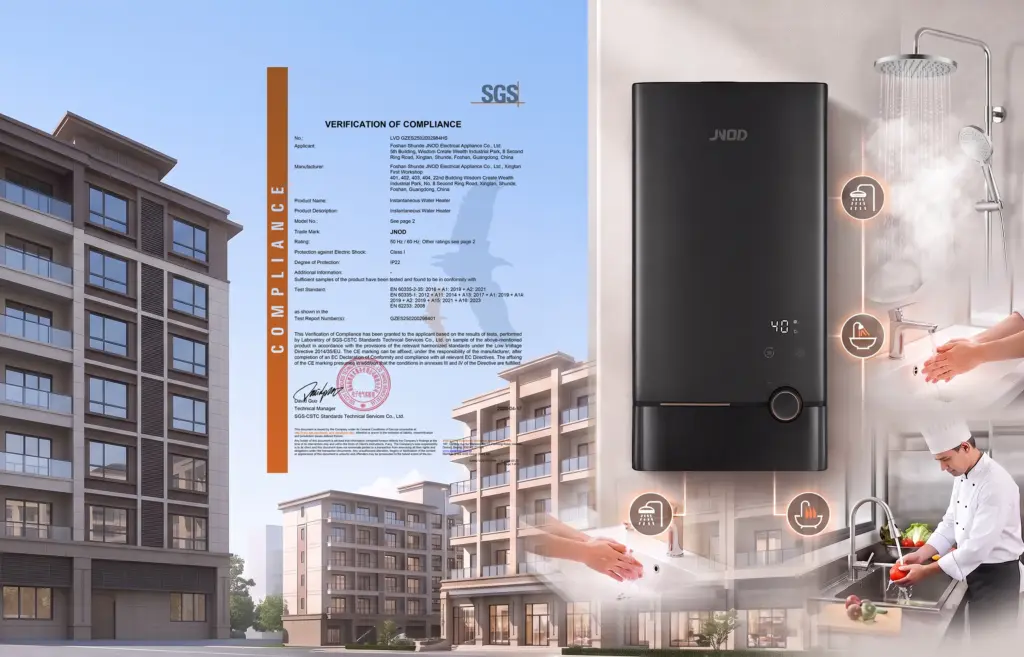
Quick Answer
Electric water heater certifications depend on the destination market, product type, electrical configuration, and applicable regulations.
There is no single certification package for every electric water heater. Requirements vary by destination market, product type, electrical configuration, intended use, and applicable regulations.
| Certification, Mark, or Requirement | Main Purpose | What Wholesale Buyers Should Check |
|---|---|---|
| CE marking | EU/EEA conformity | Applicable EU requirements, technical documents, Declaration of Conformity |
| CB certification | International electrical product certification scheme | Exact model, test report, applicable IEC standard |
| ETL Listed Mark | North American product safety certification | Exact model, applicable safety standard, listing status |
| LVD | EU electrical safety requirements | Whether the product falls within the applicable legislation |
| EMC | Electromagnetic compatibility requirements | Applicable requirements and test documentation |
| RoHS | Restrictions on certain substances | Whether the requirement applies to the target market |
| Local approvals | Country-specific compliance | Local rules and product scope |
The basic rule is simple:
Check the market, model, standard, and documents together.
For product information, see the JNOD electric water heater range.
Why Electric Water Heater Certifications Matter to Wholesale Buyers
A homeowner may buy one water heater. A wholesaler may purchase hundreds or thousands of units for distribution, retail, or project supply.
That difference changes the risk.
For example, a missing document found during sample approval may still be manageable. However, discovering the same problem after mass production or shipment can create delays and extra costs.
Depending on the target market, buyers may need compliance documents for:
- Product registration
- Electrical inspection
- Project approval
- Distributor or retailer requirements
- Import or market-entry checks
- Customer documentation
For products covered by CE-marking legislation, manufacturers must identify the applicable EU requirements, complete the relevant conformity assessment, prepare technical documentation, and issue an EU Declaration of Conformity where required.
The European Commission’s CE marking guidance explains the manufacturer’s responsibilities.
Therefore, wholesale buyers should check compliance during supplier evaluation, before production starts.
CE Marking: What Wholesale Buyers Should Check
CE is one of the most common markings for products entering the European market. However, suppliers sometimes describe it too broadly.
CE marking is not a general safety certificate issued by the European Union.
For a product that falls under CE-marking legislation, the manufacturer must first identify the applicable EU requirements. The manufacturer then completes the required conformity assessment, prepares the technical documentation, and issues the EU Declaration of Conformity where required.
Only after the manufacturer meets the applicable requirements can it apply the CE marking.
So, when a supplier says:
“This model is CE certified.”
ask a few practical questions:
- Which EU legislation applies?
- Which standards did the manufacturer use?
- Is the EU Declaration of Conformity available?
- Which models does the documentation cover?
- Does the documentation match the rated voltage and power?
Do Not Check the Logo Alone
Two water heaters may look almost identical but use different heating elements, control systems, voltages, or power ratings.
For that reason, the compliance documents should match the exact version you plan to order.
This point becomes even more important for OEM projects. For example, a change in voltage, rated power, heating components, or controls can affect the product configuration and may require the manufacturer to review the compliance documentation again.
What Is CB Certification?
The CB Scheme provides an international framework for testing and certifying electrical products against relevant IEC standards.
For wholesale buyers, CB certification can simplify international sourcing because participating certification bodies can recognize CB test results within the scheme.
However, a CB certificate does not automatically replace every national approval.
Before placing an order, check:
- Exact model
- Rated voltage
- Rated power
- Applicable IEC standard
- Test report
- Certificate number
- Destination-market requirements
For instantaneous electric water heaters, IEC 60335-2-35 is the relevant product safety standard within its scope.
In practice, the buyer should look at the certificate, the test report, the standard, and the product specification as one package.
What Is the ETL Listed Mark?
For electric water heaters intended for the United States or Canada, wholesale buyers may encounter the ETL Listed Mark.
Intertek explains that the ETL Listed Mark shows that Intertek has independently tested and certified the product to applicable safety standards through its NRTL program.
For buyers, that means an ETL logo in a product catalog is not enough.
Check:
- Manufacturer
- Model number
- Applicable safety standard
- Rated electrical configuration
- Listing status
The listing should match the actual product you plan to purchase.
For North American projects, independent listing verification can give buyers more confidence than simply accepting a certification logo from a supplier.
Certificate, Test Report, and Declaration of Conformity
Suppliers often group these documents, but each one serves a different purpose.
Certificate
A certification body issues a certificate under a defined certification scheme. The certificate normally identifies the product or product family that it covers.
Test Report
A test report records the results of testing against specified requirements or standards.
The report can support a certification or conformity assessment. However, a test report alone does not automatically mean that the product carries a particular certification mark.
Declaration of Conformity
For applicable CE-marked products, the manufacturer uses the EU Declaration of Conformity to formally declare that the product meets the relevant EU legislation.
Therefore, buyers should not treat these statements as equivalent:
“Tested according to an IEC standard.”
“Test report available.”
“CE marking.”
“EU Declaration of Conformity available.”
The document type, issuing organization, product scope, and applicable requirements all matter.
Do All Electric Water Heaters Need the Same Certifications?
No.
The compliance route changes with the product and the destination market.
| Factor | Why It Matters |
|---|---|
| Destination market | Regulations differ between countries and regions |
| Product type | Instantaneous, storage, and point-of-use heaters may have different requirements |
| Voltage and phase | Electrical configuration affects applicable requirements |
| Rated power | Different products may require different evaluation |
| Intended use | Household and commercial applications can involve different requirements |
| Installation environment | Local electrical and installation rules may apply |
| Product modifications | Design changes can affect an existing compliance assessment |
For example, a lower-power single-phase point-of-use heater and a 24 kW three-phase commercial heater have very different electrical configurations.
Therefore, buyers should verify the specific model and configuration instead of assuming that every product from the same manufacturer has the same certification package.
For more product options, see the JNOD tankless water heater range.
Why the Model Number Matters
This is one of the easiest checks to miss during sourcing.
A supplier may hold a certificate for one product family, while the model you plan to order uses a different electrical configuration.
Before accepting a compliance document, compare it with the product specification:
- Model number
- Product type
- Rated voltage
- Rated frequency
- Rated power
- Phase
- Applicable standard
- Manufacturer name
For example, the JNOD FDCHE three-phase instant water heater uses a 400 V 3-phase supply and offers 9–24 kW power options. Its product page also lists CE, CB, LVD, and EMC.
The important point is not simply that JNOD has these certifications.
The documentation needs to cover the actual model and configuration being ordered.
What Certifications Does JNOD Provide?
JNOD’s company and product documentation includes different certifications and compliance records for different products and markets.
The company’s certification history includes CE, CB, ETL, RoHS, GCC, SASO Energy, and other market-related testing and compliance work.
However, the certification package can vary by:
- Product model
- Electrical configuration
- Product version
- Destination market
- Applicable standard
For example, the FDCHE three-phase model lists CE, CB, LVD, and EMC, while other JNOD models may have a different certification combination.
For wholesale buyers, the useful question is therefore not:
“How many certifications does this manufacturer have?”
It is:
“Which certifications and compliance documents are available for the exact model I need for my market?”
The JNOD company profile provides more information about the company’s manufacturing background and certification history.
From a manufacturer’s perspective, model-level verification becomes especially important when an OEM buyer requests a different voltage, power rating, control system, or other product modification. The team should then confirm that the documentation still matches the final product configuration.
What Should Wholesale Buyers Ask a Manufacturer?
Before placing an order, ask the supplier to confirm the compliance documents for the exact models you plan to buy.
Which certifications are available?
Ask for the actual documents rather than relying on certification logos in a catalog.
Which models are covered?
Confirm the exact model number and, where relevant, the product family.
Which standards were used?
Check the standard reference so you know which technical requirements the product met during testing or assessment.
Does the electrical specification match?
Compare voltage, frequency, phase, and rated power with the product you plan to order.
Is the documentation current?
Check the issue date and validity information where applicable, especially after product modifications.
Can the certification be verified?
For third-party marks, use the certification body’s verification system when available.
Can you provide the Declaration of Conformity?
For applicable CE-marked products, request the relevant EU Declaration of Conformity.
A reliable supplier should answer these questions clearly and provide documentation that matches the actual product.
Common Certification Mistakes to Avoid
Choosing a supplier because it displays more logos
More certification logos do not automatically make a product more suitable.
Instead, check whether the documents cover your target market and the actual model.
Assuming CE means EU approval
CE marking forms part of the applicable EU conformity framework. It is not simply an EU-issued safety certificate.
Checking the manufacturer but not the model
A manufacturer’s certification portfolio can cover several products with different scopes.
Using documents for an older product version
Changes to heating elements, control systems, electrical configurations, or rated power can affect the compliance assessment.
Assuming one certification covers every country
A product may meet one market’s requirements and still need additional assessment or local approval elsewhere.
Providing the destination market at the beginning of the sourcing process helps the manufacturer identify the appropriate documentation.
Electric Water Heater Certification Checklist for Wholesale Buyers
| Check | Question |
|---|---|
| Market | Where will the product be sold or installed? |
| Model | Does the document cover the exact model? |
| Standard | Which standard was used? |
| Electrical rating | Do voltage, phase, frequency, and power match? |
| Documents | Are the relevant certificates, reports, or declarations available? |
| Verification | Can third-party certification be independently checked? |
| Product changes | Has the product changed since testing or certification? |
This checklist does not require buyers to become certification specialists. Instead, it helps them confirm that the product, documents, and market requirements are aligned.
FAQ
There is no single certification package for every electric water heater. Requirements depend on the destination market, product type, electrical configuration, intended use, and applicable regulations.
Commonly encountered marks, certification schemes, and compliance requirements include CE, CB, ETL, EMC, LVD, RoHS, and local approvals.
CE marking forms part of the EU conformity framework. Buyers should check all applicable EU requirements for the specific product and confirm that the manufacturer has completed the required conformity assessment and documentation.
Not necessarily. Requirements depend on the product, installation, jurisdiction, applicable codes, and market conditions.
When a product carries the ETL Listed Mark, buyers should verify that the listing covers the actual product being purchased.
CE marking belongs to the European conformity framework. ETL is a third-party product certification mark issued by Intertek through its NRTL program for products evaluated to applicable safety standards.
They operate within different market and regulatory frameworks.
No.
A test report records test results against defined requirements. Certification is issued under a certification scheme. A test report may support certification or conformity assessment, but it is not automatically equivalent to a certification mark.
No. Certification can vary by model, electrical configuration, product version, and destination market.
Wholesale buyers should confirm the documentation for the exact JNOD model they intend to purchase.
Conclusion
For wholesale buyers, electric water heater certifications are part of the sourcing process, not simply marketing labels.
The process is straightforward:
Define the destination market. Check the exact model. Identify the applicable standard. Review the supporting documents. Make sure the electrical specifications match.
The number of certification logos on a supplier’s website matters less than whether the supplier can clearly explain which product is covered, which standard was used, which market the documentation supports, and what documents are available.
JNOD develops electric water heating products for different applications and electrical configurations. Wholesale buyers can review the FDCHE three-phase instant water heater as one example of model-level product and certification information.
Need Electric Water Heaters for Your Market?
Send JNOD your destination market, required model, voltage, power range, and application.
We can provide the relevant product specifications and available compliance documentation for your project.
 English
  Arabic
  Russian
  Spanish