
When an electric tankless water heater is not heating, the problem may involve insufficient water flow, an electrical supply issue, or an activated safety protection function. A failed heating element is only one possibility.
For distributors, installers, and service technicians, identifying the symptom is the first step toward an accurate diagnosis. A heater that produces no hot water requires a different investigation from one that runs but cannot reach the desired temperature.
This guide explains the common causes, safe initial checks, and situations that require professional service.
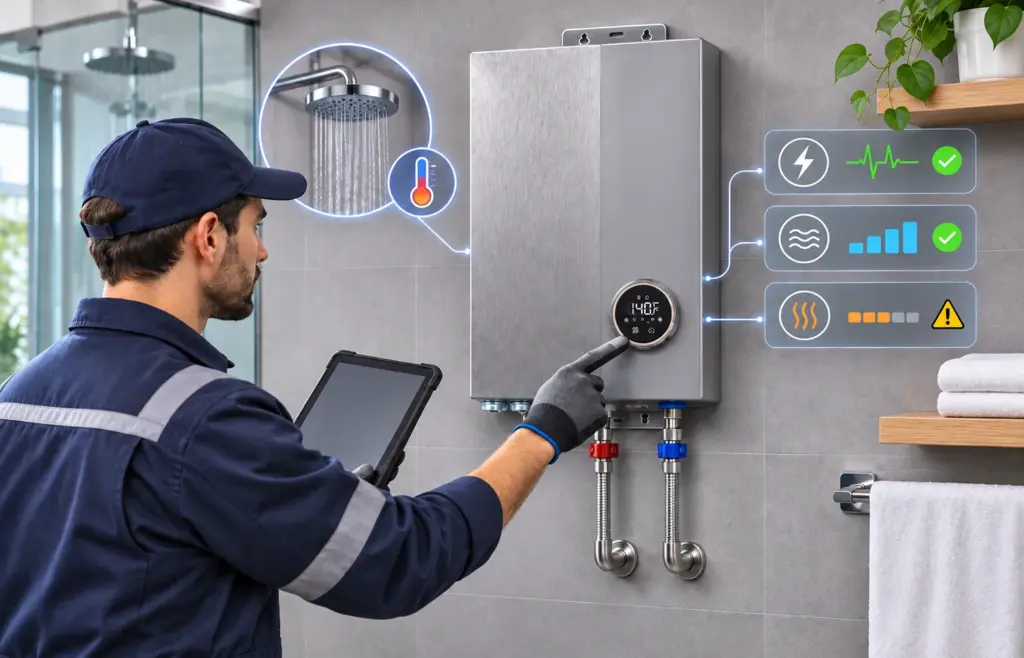
Quick Answer: Why Is an Electric Tankless Water Heater Not Heating?
Start with the external power supply and water flow. Then compare the heating demand with the unit’s rated capacity and check any model-specific warning messages. Internal components should only be inspected by qualified personnel.
| Symptom | Possible Cause | First Check |
|---|---|---|
| Blank display and no hot water | Power issue, standby operation, or control fault | Check external power status and operating instructions |
| Water flows but heating does not start | Flow below activation threshold or protection condition | Check flow and fault indications |
| Water is only lukewarm | Excessive flow or insufficient heating power | Compare flow and temperature rise with rated capacity |
| Heating starts and stops | Unstable flow or protective shutdown | Observe flow stability and warnings |
| Error code appears | Model-specific fault or protection event | Record the code and consult the correct manual |
These symptoms help narrow down the problem, but they do not confirm which component has failed.
1. No Power or Blank Display
If the heater shows no sign of operation, start by checking the available electrical supply.
However, display behavior differs between models. Some heaters keep their screens illuminated in standby, while others activate the display only when sufficient water flow is detected.
Therefore, a blank display does not automatically mean the control board is damaged.
What Can Users Check Safely?
Without opening the appliance, check whether:
- The building has electrical power.
- The heater is switched on according to its instructions.
- The electrical panel indicates a tripped breaker.
- The display responds when a hot water outlet opens.
- Any warning or fault indication is visible.
If a breaker trips repeatedly, stop using the heater and arrange an inspection by a qualified electrician. Repeated resets may conceal an electrical fault.
For a newly installed unit, the electrician should confirm that the supply voltage, circuit configuration, and protective devices match the product’s rating and installation requirements.
Never open the heater or inspect internal wiring while the appliance is energized.
2. Water Flow Is Too Low to Activate Heating
Most electric tankless water heaters require a minimum water flow before their heating systems activate.
If flow falls below this threshold, the heater may remain in standby even though water comes out of the faucet.
Common causes include:
- A partially closed supply valve
- A restricted faucet aerator or showerhead
- A blocked inlet filter
- Insufficient water supply
- Restrictions in the plumbing system
Check the Actual Water Flow
First, observe whether the water flow is weaker than normal.
If it is, check for obvious external restrictions and compare the available flow with the heater’s minimum activation requirement.
Minimum activation flow varies by model. Do not apply one manufacturer’s specification to every electric water heater.
Also, remember that water pressure and water flow are different measurements. A plumbing system may have adequate static pressure while a restriction prevents enough water from passing through the heater.
JNOD discusses this issue further in its guide to instant shower water heaters for low-water-pressure applications.
If the problem requires inlet filter servicing or internal inspection, follow the model-specific procedures and use qualified personnel where required.
3. Water Is Warm but Not Hot Enough
A heater that operates but produces lukewarm water is not necessarily faulty.
Every electric tankless water heater has a limited heating capacity. As water flow increases, the temperature rise it can provide decreases unless sufficient additional power is available.
Check Flow Rate, Temperature Rise, and Power
For example, consider these operating conditions:
| Parameter | Value |
|---|---|
| Water flow | 6 L/min |
| Inlet temperature | 15°C |
| Desired outlet temperature | 40°C |
| Required temperature rise | 25°C |
The approximate thermal power required is:
Power (kW) ≈ Flow (L/min) × 0.0698 × Temperature Rise (°C)
Therefore:
6 × 0.0698 × 25 ≈ 10.5 kW
Under these conditions, the heater must deliver approximately 10.5 kW of heat to the water. Its required electrical input may be slightly higher because of energy losses.
A 9 kW heater cannot maintain the specified 6 L/min flow and 25°C temperature rise continuously, even under ideal conditions. This is a capacity limitation rather than proof of a defective component.
The U.S. Department of Energy’s Building America instantaneous water heater sizing tool also uses water flow and temperature rise to assess heating requirements.
For further guidance, see JNOD’s instant electric water heater kW selection guide.
What Should Be Checked?
Before reporting a heating failure, confirm:
- Selected outlet temperature
- Actual water flow
- Incoming water temperature
- Rated heating power
- Simultaneous hot water demand
- Available electrical supply
Reducing the flow may allow a higher outlet temperature, provided the flow remains above the activation threshold and within the manufacturer’s operating limits.
If performance remains below the published specification under suitable test conditions, a qualified technician should investigate further.
4. Heating Starts and Stops During Use
Intermittent heating can result from changing operating conditions rather than a permanently damaged component.
For example, a heater may start normally but stop heating when water flow becomes unstable or a protection function activates.
Unstable Water Flow
If flow repeatedly drops below the activation threshold, the unit may stop and restart heating.
This can happen when multiple fixtures share a limited supply, a mixing valve affects the flow through the heater, or a plumbing restriction reduces available water.
A service technician should confirm flow stability before replacing the flow sensor.
Safety Protection
Depending on the model, electric tankless water heaters may include protection against overheating, abnormal electrical conditions, or other unsafe operating states.
When protection activates, the heater may stop heating or display a warning.
Do not bypass protective devices or repeatedly restart a heater that shuts down for an unknown reason.
If the problem persists, discontinue operation and arrange professional inspection.
5. Understanding Error Codes and Warning Messages
Some electric tankless water heaters use built-in fault detection to help identify abnormal operating conditions.
For example, JNOD’s JNE instant electric water heater lists automatic fault detection among its product features.
However, error-code meanings differ by model and control system. A code used by one heater may indicate something completely different on another.
Always use the correct model-specific manual to interpret a fault code.
If the meaning is unclear, record the displayed code and contact the manufacturer’s technical support team. Avoid resetting protection functions or replacing components based on an unrelated model’s fault-code list.
6. When Should Internal Components Be Inspected?
If the external supply, water flow, and heating demand have been checked but the heater still fails to operate correctly, qualified technicians may need to inspect internal components.
| Component | Possible Issue | Diagnostic Consideration |
|---|---|---|
| Flow sensor or switch | Heating demand not detected | Confirm actual flow and sensor operation |
| Temperature sensor | Incorrect temperature feedback | Check approved sensor specifications |
| Heating assembly | Reduced or absent heat generation | Verify power rating and diagnostic findings |
| PCB or control board | Heating control fault | Check model and firmware compatibility |
| Electrical connections | Inadequate power delivery | Qualified electrical inspection required |
| Protection devices | Heating interrupted | Identify the underlying cause before an authorized reset |
These components are possible areas of investigation, not a recommendation to replace them without testing.
Avoid Unnecessary Parts Replacement
A faulty-looking heater may simply be operating below its minimum activation flow or beyond its rated heating capacity.
Replacing a working PCB or heating assembly will not solve those problems.
Therefore, technicians should follow the manufacturer’s approved diagnostic process before ordering replacement parts. Some designs also require complete assembly replacement rather than individual component servicing.
JNOD’s earlier guide to common tankless water heater problems covers broader maintenance issues, including those affecting gas-powered systems. This article focuses specifically on electric heating failures.
Electrical Safety
Internal testing and repair must be carried out by qualified personnel.
Before servicing the unit, technicians must follow applicable procedures for electrical isolation, verification of safe conditions, and control of stored energy or water pressure.
The U.S. Occupational Safety and Health Administration provides guidance on controlling hazardous energy during servicing and maintenance.
Never bypass a safety device or install an unapproved replacement component.
7. Troubleshooting Checklist for Distributors and Service Teams
Distributors often support several electric water heater models with different electrical ratings, controls, and service requirements.
A consistent fault report helps the manufacturer identify the correct product configuration and review the reported problem.
Use this checklist before escalating a technical support case.
| Checkpoint | Information to Record |
|---|---|
| Product identification | Model, serial number, and rating label |
| Main symptom | No heat, lukewarm water, or intermittent heating |
| Display status | Blank, normal, warning, or error code |
| Electrical supply | Rated supply and qualified inspection findings |
| Water conditions | Flow rate and inlet temperature |
| Heating performance | Setpoint and measured outlet temperature |
| Installation history | New installation or previously working unit |
| Maintenance history | Previous faults or repairs |
| Supporting evidence | Photos, videos, and service records |
Where possible, include the operating conditions when the fault occurred. This helps distinguish installation issues, capacity limitations, and potential component failures.
Technical Support from JNOD
JNOD provides technical training, after-sales support, and accessories supply for distribution partners.
When requesting assistance, provide the model number, fault symptoms, operating conditions, and relevant diagnostic records.
The technical team can review the case and discuss suitable next steps, including authorized servicing or compatible replacement parts where applicable.
Warranty coverage, repair authorization, and component availability depend on the product and agreed service arrangements.
FAQ
Possible causes include insufficient activation flow, electrical supply problems, a protection condition, or an internal fault. Check the model’s operating requirements before assuming the heating element has failed.
Yes, if low pressure or a restriction reduces water flow below the heater’s activation threshold. The minimum required flow depends on the model.
The heater may lack sufficient power for the actual flow rate and required temperature rise. Compare the inlet temperature, outlet temperature, and flow with its rated performance.
Not without a verified diagnosis. Flow restrictions, power problems, and control faults can produce similar symptoms. Qualified technicians should identify the cause before replacing parts.
Conclusion
An electric tankless water heater not heating does not automatically indicate a failed heating element or control board.
Accurate troubleshooting begins with the operating conditions. By identifying the symptom, checking the available water flow and heating capacity, and reviewing model-specific fault information, service teams can avoid unnecessary component replacements.
For distributors, clear diagnostic records also make technical support and warranty communication more efficient.
Need Technical Support for a JNOD Electric Water Heater?
JNOD supports distributors, wholesalers, installers, and OEM partners with electric water heating solutions and after-sales assistance.
Share your product model, fault symptoms, error codes, and relevant operating information so our team can review your inquiry.
 English
 Arabic
 Russian
 Spanish