
A tankless water heater recirculation pump can shorten the wait for hot water at distant faucets and showers. Instead of wasting the cooled water left in the hot water line, a properly designed system returns it for reheating.
But a pump alone is not enough. Electric tankless heaters have specific flow and temperature controls, and not every model supports a return loop. For installers, distributors, and project buyers, the essential questions are how circulation works, what the plumbing requires, and whether the selected heater is compatible.
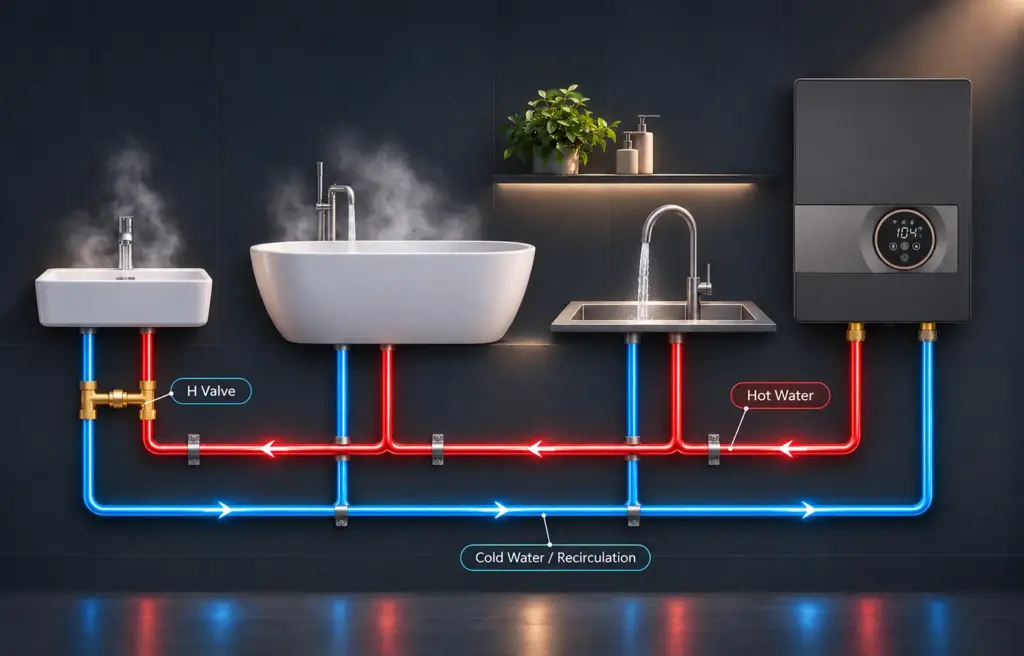
How Does a Tankless Water Heater Recirculation Pump Work?
A recirculation pump moves water through a hot water distribution loop before someone opens a fixture. The aim is to bring heated water closer to the outlet.
A typical cycle has four steps:
- Start: A button, timer, or temperature-based controller activates the pump.
- Return: Cooled water in the hot water line moves through an approved return path.
- Reheat: A compatible heating arrangement restores the water temperature as needed.
- Stop: The controller ends the cycle when its target condition is reached.
The reheating arrangement varies. Some electric tankless systems have controls designed for circulating water; others need additional components or are not suitable for recirculation. In some approved arrangements, water passes through the main heater; in others, a separate component helps maintain loop temperature. The pump, heater, and controls must function as one installation. A product description that simply says “built-in pump” does not establish the flow path.
When Is a Recirculation System Worth Installing?
A hot water recirculation system is most useful when long pipe runs cause noticeable waiting times or several fixtures share a central water heater. However, not every installation needs one.
Before adding a pump, consider the distance to the outlets, how often hot water is used, and whether the plumbing can accommodate a return path.
| Project Scenario | What to Consider |
|---|---|
| Short pipe runs | Recirculation may offer little benefit when hot water already reaches fixtures quickly. |
| Long distance to a bathroom | Evaluate recirculation if the waiting time causes regular water waste or inconvenience. |
| New multi-bathroom construction | A dedicated return line can be incorporated into the plumbing design where justified. |
| Renovation without a return pipe | An approved crossover valve system may reduce additional pipework. |
| Hotels and multi-fixture buildings | Assess circulation flow, balancing, temperature maintenance, and energy use across the network. |
Start with the plumbing layout, not the pump. In some projects, moving the heater closer to frequently used outlets or reducing unnecessary pipe length may be more practical than adding recirculation.
For electric tankless heaters, confirm circulation compatibility before choosing either return-line arrangement.
Why Does Hot Water Take Time to Reach the Faucet?
Tankless heaters heat water on demand, but water remaining in the pipe cools between uses. When the faucet opens again, that water must leave before newly heated water arrives.
Pipe length and internal diameter largely determine how much water is waiting in the line. Fixture flow rate, insulation, and heater response also affect the delay.
Example: A 20 m pipe with a 15 mm internal diameter holds approximately 3.5 L of water:
- Pipe volume: π × (0.0075 m)² × 20 m ≈ 3.53 L
- At 6 L/min, displacement time: 3.53 ÷ 6 × 60 ≈ 35 seconds
This assumes steady flow and excludes the heater’s response time. Real installations include fittings, branches, and sometimes a mixing valve, so actual results vary. The example is useful for estimating the amount of water in a pipe, not for predicting a guaranteed delivery time or calculating total savings.
Recirculation can reduce this delay, but short pipe sections between the loop and a fixture may still contain cooled water. “Zero cold water” should therefore not be read as a guarantee of zero waiting time at every outlet.
Dedicated Return Line vs. Crossover Valve
Every recirculation system needs a route back toward the heating equipment. Two approaches are common.
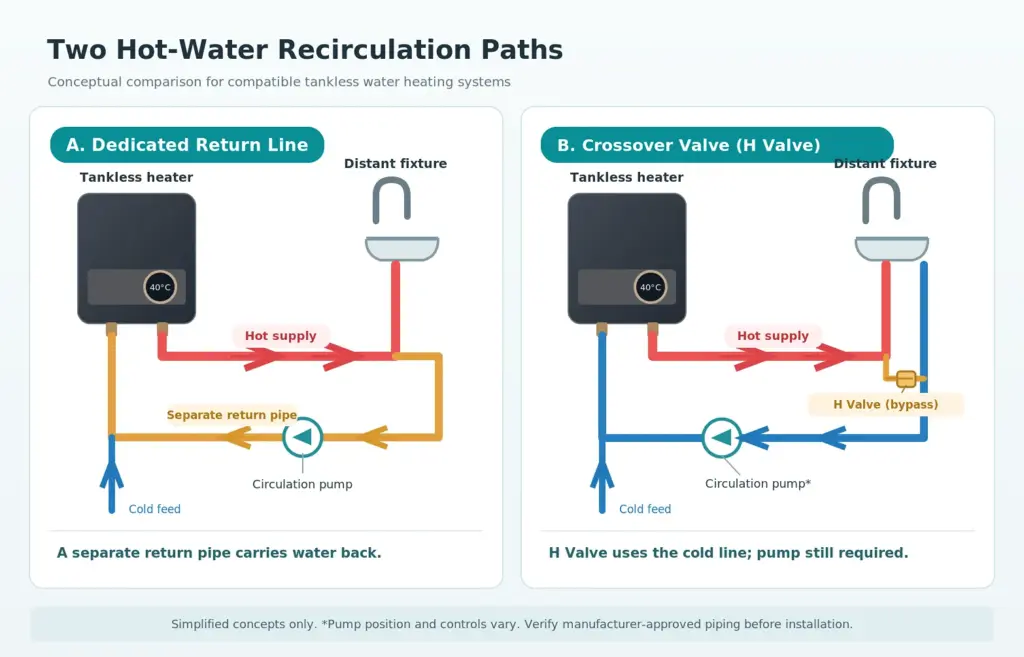
Dedicated Return Line
A separate return pipe creates a defined circulation loop. It is practical for new construction and projects where pipe sizing and routing can be planned early. Systems with multiple branches may also require balancing to maintain appropriate flow.
Crossover Valve
Some approved retrofit systems use a thermostatic crossover valve near a distant fixture, allowing water to return through part of the cold water piping. This can reduce new pipework but may temporarily warm the cold water supply.
| Feature | Dedicated Return Line | Crossover Valve |
|---|---|---|
| Return path | Separate pipe | Approved cold water pipe |
| Typical application | New construction, planned systems | Selected retrofits |
| Additional pipework | Usually more | Often less |
| Main consideration | Sizing and balancing | Compatibility and cold-line warming |
Neither arrangement is universally suitable for electric tankless heaters. The manufacturer’s approved hydraulic diagram should determine the installation. Where several fixtures share a loop, the return connection point matters too: a loop ending before the farthest branch may leave that branch with a long wait.
Built-In vs. External Recirculation Pumps
A built-in recirculation pump is integrated into a system designed to support circulation. It may simplify installation and control coordination, but the supported pipework and operating modes still matter.
By contrast, installers select an external recirculation pump separately. The pump must deliver the required flow against the loop’s pressure loss, while the heater must support the resulting operating conditions.
Is a Built-In DC Pump a Recirculation Pump?
Not necessarily. “DC” identifies the motor’s electrical supply, not its function.
A booster pump improves water pressure or flow. A recirculation pump moves water through a return loop to reduce hot water waiting time. Some DC pumps are designed for recirculation, but a pressure-boosting pump should not be treated as one without supporting specifications.
Check the pump’s intended duty, water temperature rating, flow and head, and control requirements before making that claim.
Can You Add Recirculation to Any Electric Tankless Water Heater?
No. Many electric tankless heaters activate when flow exceeds a specified threshold. Recirculation can create flow while every faucet is closed, which is different from normal draw-off operation.
Before specifying a pump, check four areas.
Minimum Activation Flow
The circulation flow must work with the heater’s activation requirements. If it is too low, the heating elements may not turn on. Increasing pump capacity is not automatically the answer; excess flow can create noise, pressure loss, and unnecessary energy use.
Return-Water Temperature and Controls
Returning water may already be warm. The heater must regulate heating under those conditions without rapid cycling, overheating, or unwanted shutdowns. Some systems use dedicated controls or additional heating equipment.
Pump and Pipework
Size the pump for the complete loop, including fittings, valves, and branch losses—not simply the heater’s rated kilowatts. Confirm the pump’s flow, head, duty cycle, temperature limit, and suitability for potable hot water.
Approved System Layout
Ask for an installation diagram showing the return connections, required valves, sensors, and control method. A conventional heater should not be assumed compatible with an external pump simply because water can pass through it.
Does Hot Water Recirculation Save Water and Energy?
A properly controlled loop can reduce the water discharged while waiting for hot water. Energy savings are less certain.
The pump uses electricity, while heated water loses energy through the pipes. The heater must replace that heat. ENERGY STAR’s guidance on demand hot water recirculating systems explains why demand control can limit waste and why continuous circulation may increase energy use.
| Control Method | Operation | Main Trade-off |
|---|---|---|
| Continuous | Runs throughout the day | Higher potential heat loss |
| Timer | Runs during scheduled periods | Depends on predictable demand |
| Temperature-based | Responds to a sensor | Depends on sensor placement and settings |
| On-demand | Runs when requested | Avoids circulation between many uses |
For apartments, hotels, and other multi-fixture projects, consider more than convenience. Pipe insulation, hydraulic balancing, temperature management, and local water hygiene requirements affect the system’s performance. A continuously circulating loop may keep pipes warm all day, even during hours of low demand. Conversely, long or poorly balanced branches may cool too much between circulation cycles. The right control schedule depends on the building’s actual usage pattern.
The ASHRAE Handbook’s service water heating guidance addresses distribution and circulation design.
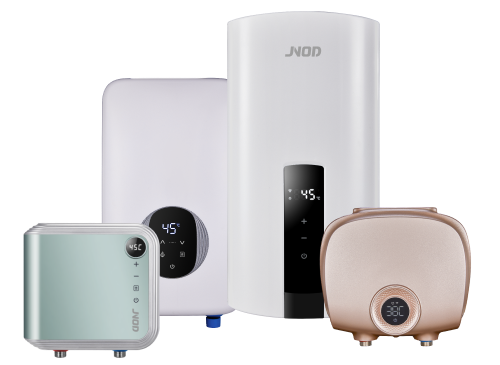
JNOD Zero-Cold-Water Technology and Product Options
JNOD has described patented zero-cold-water technology that uses a circulation pump to return and reheat cooled water remaining in the hot water pipe.
That establishes the principle of the patented design. It does not mean every model with a zero-cold-water feature has the same built-in pump or piping arrangement.
| Product | Published Information | Check Before Ordering |
|---|---|---|
| JN Shower Water Heater | Describes return-water circulation heating; zero-cold-water is optional | Included configuration, pump arrangement, return connections |
| FM-Z Three-Phase Instant Water Heater | Lists zero-cold-water and built-in DC pump; 400V three-phase, 9–24 kW options | Whether the pump serves recirculation, boosting, or both; required piping |
JN explicitly refers to return-water circulation heating. FM-Z lists a DC pump, but its product description associates the pump with pressure boosting. Buyers should not assume it is an integrated recirculation pump without the corresponding technical documentation.
For related capacity considerations, read JNOD’s three-phase electric water heater guide.
Installation and Purchasing Checklist
To recommend a suitable system, distributors and installers need more than a pump specification.
| Item | What to Confirm |
|---|---|
| Heater model | Is recirculation approved for the exact configuration? |
| Pump role | Recirculation, boosting, or both? |
| Return path | Dedicated return or approved crossover? |
| Operating limits | Circulation flow, pump head, water temperature, duty cycle |
| Controls | How does the heater respond to warm return water? |
| Documentation | Hydraulic diagram, commissioning instructions, service parts |
For a project with multiple outlets, provide pipe lengths, heater location, expected hot water demand, and a proposed return route. For larger networks, include branch balancing and water-temperature requirements.
Before commissioning, the installer should verify circulation direction, control response, pump operating conditions, and delivery temperature at representative fixtures. Keep the approved piping diagram and control settings with the maintenance records. This makes troubleshooting and replacement-parts planning easier for the service team.
JNOD offers technical and after-sales support for product selection and installation discussions.
FAQ
Not always. It is most useful where long pipe runs cause noticeable hot water delays. A heater installed close to the outlet may not need one.
Some approved systems use a crossover valve and cold water piping as the return path. However, installers must first confirm that the electric tankless heater supports this arrangement.
Only when the heater supports the pump’s flow and the proposed control and return-water arrangement.
No. A DC pump can be designed for pressure boosting rather than returning hot water. Check the actual pump function.
It can. Pump power and pipe heat loss add energy demand. Insulation and demand-based control can help limit unnecessary operation.
Conclusion
A tankless water heater recirculation pump can shorten hot water waiting times, but good results depend on the heater, controls, pump, and return path working together.
For electric tankless projects, confirm the approved circulation arrangement before selecting equipment. JNOD offers models with published zero-cold-water features; the exact configuration should be checked for each project.
Need help reviewing an electric water heating application? Share your electrical supply, hot water demand, and plumbing layout with JNOD.
Contact JNOD for Product Specifications and Technical Support
 English
 Arabic
 Russian
 Spanish