
Choosing the right size Tankless Electric Water Heater for a shower is not only about picking the highest wattage. The correct size depends on three key factors:
Water flow rate, incoming water temperature, and desired shower temperature.
If the unit is too small, the shower water may not be hot enough. If the unit is too large, the buyer may pay more than necessary for power capacity they do not really need.
For homeowners, distributors, contractors, and OEM/ODM buyers, understanding water heater sizing helps avoid complaints such as unstable temperature, weak hot water flow, slow heating, or incorrect installation.
This guide explains how to choose the right Instant Electric Shower Water Heater for bathroom use and how JNOD’s 3.5kW–13.5kW models can match different shower scenarios.
Quick Answer: What Size Tankless Electric Water Heater Do You Need for a Shower?
For shower use, many buyers should consider a higher-power electric tankless water heater, especially when the inlet water is cold or the required shower flow is high.
As a general reference:
| Application Scenario | Suggested Power Range |
|---|---|
| Handwashing / small sink | 3.5kW–5.5kW |
| Low-flow shower in warm climates | 5.5kW–8.5kW |
| Standard shower in mild climates | 8.5kW–11kW |
| Stronger shower flow or cooler inlet water | 11kW–13.5kW |
| Cold climates or high-flow showers | Higher capacity may be required |
For a comfortable shower, the key is not only wattage. You need to calculate the temperature rise and match it with the required water flow rate.
The U.S. Department of Energy explains that demand water heaters are typically sized by determining the required flow rate and the needed temperature rise. It also notes that electric demand water heaters usually provide a lower flow rate than gas models at the same temperature rise, so correct sizing is especially important for electric shower use.
What Does “Size” Mean for a Tankless Electric Water Heater?
When people ask, “What size water heater do I need?”, they may be referring to different things.
For a Tankless Electric Water Heater, “size” usually means:
- Power rating, measured in kW
- Heating capacity, meaning how much water it can heat per minute
- Temperature rise, meaning how many degrees it can raise the water temperature
- Electrical requirement, including voltage, wiring, and breaker capacity
- Application match, such as sink use, shower use, apartment bathroom, hotel room, or low-pressure water system
Unlike a storage water heater, a tankless unit does not store hot water. It heats water instantly as water flows through the unit. This is why wattage and flow rate are so important.
The Core Formula: Flow Rate + Temperature Rise
To choose the correct Water Heater Instant Electric model, use this simple method:
Required heating power depends on how much water flows through the heater and how much the heater needs to raise the water temperature.
The basic logic is:
Higher water flow = more power needed
Colder inlet water = more power needed
Higher target temperature = more power needed
For example:
- If your cold water is 25°C and you want 40°C shower water, the temperature rise is only 15°C.
- If your cold water is 10°C and you want 40°C shower water, the temperature rise is 30°C.
The second case needs about twice as much heating energy for the same water flow.
Step 1: Know Your Shower Flow Rate
The first step is to estimate how much water your shower uses per minute.
A low-flow shower may use around 4–6 L/min. A stronger shower may use 7–10 L/min or more. In tankless water heater sizing, flow rate is one of the most important factors because the heater must heat water continuously while the shower is running.
The Department of Energy recommends adding up the flow rates of the hot water devices you want to use at the same time when sizing a demand water heater. For a shower-only unit, the main calculation is usually based on the shower flow rate.
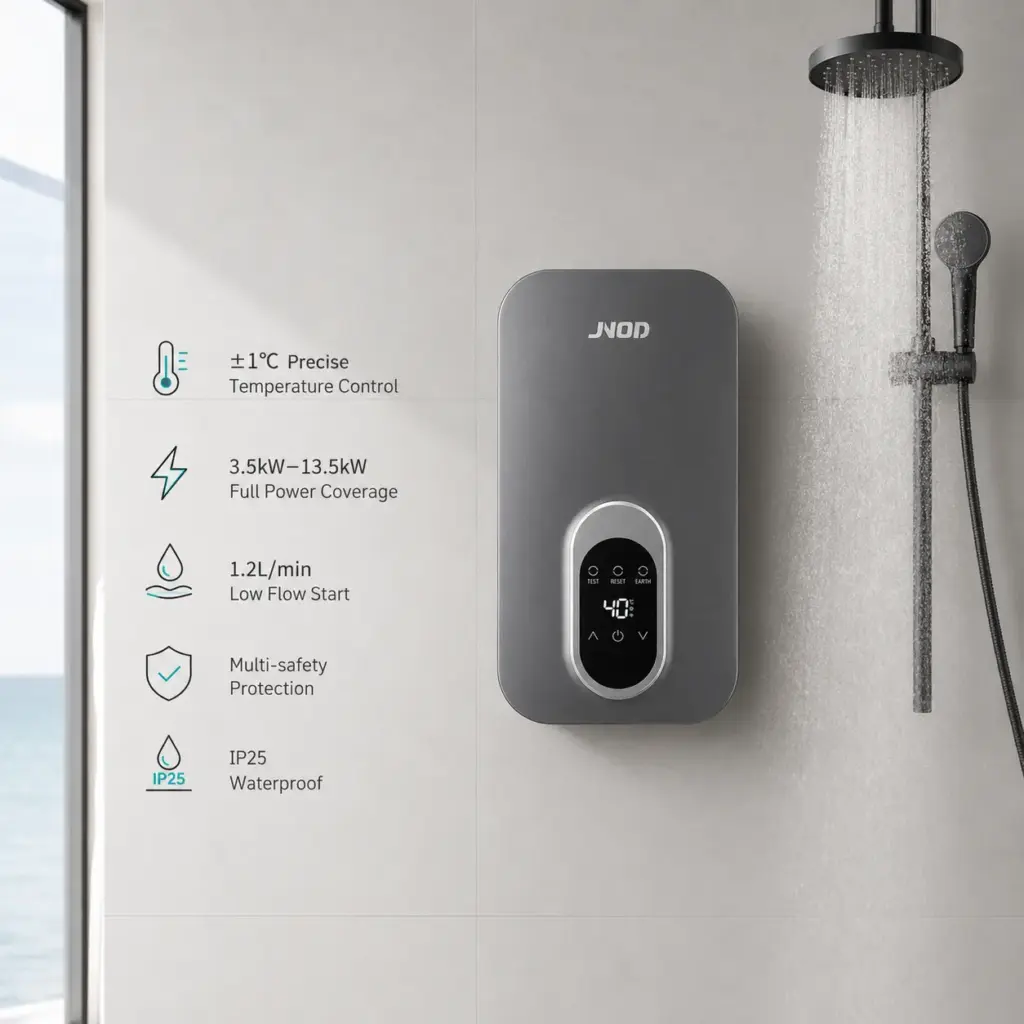
For JNOD’s instant electric shower water heaters, the minimum active water flow is 1.2 L/min, which helps the unit start even under lower-flow conditions.
Step 2: Check Your Inlet Water Temperature
The same electric water heater performs differently in different climates.
For example:
| Region Type | Approximate Inlet Water Situation | Heating Difficulty |
|---|---|---|
| Tropical / warm climate | Warmer incoming water | Easier to heat |
| Mild climate | Moderate incoming water | Medium difficulty |
| Cold climate | Cold incoming water | More difficult to heat |
A 5.5kW instant shower heater may perform well in a warm climate with low-to-medium flow, but it may not be enough for a cold region where the incoming water temperature is much lower.
This is why many buyers should not choose only by wattage. They should calculate the required temperature rise first.
Step 3: Decide Your Target Shower Temperature
Most users prefer shower water around 38°C–42°C. Some users may prefer a warmer shower, but higher temperature settings require more power.
JNOD tankless electric water heaters support a 30°C–60°C temperature range, allowing users to set the water temperature directly according to comfort needs.
The unit’s auto thermostatic control helps maintain constant temperature within ±1°C, reducing hot-and-cold fluctuation during showering.
Simple Sizing Examples
Here are practical examples to help buyers understand how wattage affects shower performance.
Example 1: Warm Climate, Low-Flow Shower
Assumptions:
- Inlet water temperature: 25°C
- Target shower temperature: 40°C
- Required temperature rise: 15°C
- Shower flow: 4–5 L/min
In this case, a mid-range Instant Electric Water Heater may be suitable because the heater does not need to raise the water temperature too much.
Suggested range: 5.5kW–8.5kW
This type of application is common in warm regions, apartments, rental homes, and compact bathrooms.
Example 2: Mild Climate, Standard Shower
Assumptions:
- Inlet water temperature: 18°C
- Target shower temperature: 40°C
- Required temperature rise: 22°C
- Shower flow: 5–6 L/min
This is a more demanding situation. A lower-power heater may provide warm water, but the user may need to reduce the water flow to keep the temperature stable.
Suggested range: 8.5kW–11kW
This is a common choice for standard bathroom shower applications.
Example 3: Cooler Inlet Water or Stronger Shower Flow
Assumptions:
- Inlet water temperature: 10°C–15°C
- Target shower temperature: 40°C
- Required temperature rise: 25°C–30°C
- Shower flow: 6–8 L/min
In this case, higher power is needed. If the wattage is too low, the heater may not maintain the desired temperature at stronger flow.
Suggested range: 11kW–13.5kW or higher depending on actual site conditions
For colder regions, project buyers should carefully confirm local inlet water temperature, wiring capacity, breaker capacity, and expected shower flow before choosing the model.
JNOD Tankless Electric Water Heater Sizing Reference
JNOD offers 3.5kW–13.5kW tankless electric water heater options for different bathroom and point-of-use applications.
| JNOD Power Range | Best-Fit Application | Buyer Notes |
|---|---|---|
| 3.5kW | Handwashing, small sink, warm inlet water | Not recommended for standard shower use in cooler regions |
| 5.5kW | Low-flow shower, warm climates, compact bathrooms | Suitable when temperature rise is low |
| 7kW–8.5kW | Mild climate shower, apartment bathroom | Good balance of comfort and power |
| 11kW | Standard shower with higher temperature demand | Better for stable hot water output |
| 13.5kW | Stronger shower flow or cooler inlet water | Recommended for higher comfort requirements |
This table is a practical reference. The final choice should always be based on local voltage, water pressure, flow rate, inlet temperature, and installation conditions.
Why kW Matters So Much for Electric Shower Water Heaters
A gas water heater uses gas burner capacity, while an electric water heater relies on electrical power. For a Tankless Electric Water Heater, kW directly affects how fast the unit can heat flowing water.
Higher kW means stronger heating capacity.
But higher kW also means:
- Higher electrical load
- Higher wiring requirements
- Higher breaker requirements
- Need for correct installation by qualified professionals
- Possible limitations in older buildings or apartments
Therefore, the best choice is not always the highest wattage. The best choice is the wattage that matches the actual shower demand and electrical conditions.
Can a 3.5kW Electric Water Heater Be Used for a Shower?
In most cases, 3.5kW is better suited for handwashing, small sinks, or low-temperature-rise applications, not a full standard shower.
A 3.5kW unit may provide warm water at a very low flow rate in a warm climate, but it may not deliver a comfortable shower experience if the user expects strong flow and higher water temperature.
For shower use, buyers usually need to consider a higher-power Instant Electric Shower Water Heater.
Is 5.5kW Enough for a Shower?
A 5.5kW electric shower water heater may be enough in warm climates or for low-flow shower applications.
It may be suitable when:
- Inlet water is already warm
- Shower flow is low
- Target temperature is moderate
- User accepts lower water flow for higher temperature
- The bathroom is in a tropical or warm region
However, in colder regions, 5.5kW may not be enough to provide stable hot water at normal shower flow.
Is 8.5kW Enough for a Shower?
An 8.5kW tankless electric water heater is a stronger option for shower use. It may be suitable for many mild-climate bathrooms where the inlet water is not too cold and the shower flow is moderate.
This power range is often a practical balance between heating comfort and installation requirements.
For B2B buyers, 8.5kW models can be a good product line option for apartment bathrooms, rental properties, and markets with warm-to-mild inlet water temperatures.
When Should You Choose 11kW–13.5kW?
Buyers should consider 11kW–13.5kW when they need:
- Higher shower flow
- More stable temperature
- Cooler inlet water conditions
- Better winter performance
- More comfortable bathroom use
- A premium shower experience
For distributors and project buyers, higher-power models are often better suited for markets where users expect stronger hot water performance.
However, these models require proper electrical capacity, so installation conditions must be checked before purchase.
What About Water Pressure?
Water pressure is another important factor.
JNOD tankless electric water heaters are designed for a rated pressure of 0.02–0.6MPa and a minimum active water flow of 1.2 L/min.
This makes the product suitable for many bathroom applications, including some low-flow conditions. However, if the water flow is too weak, any instant water heater may struggle to start or maintain stable operation.
For low-pressure markets, buyers should check:
- Building water pressure
- Shower head flow rate
- Pipe condition
- Filter blockage
- Installation height
- Whether a booster pump is needed
A good shower water heater must match both electrical conditions and water supply conditions.
Why Constant Temperature Control Matters
One of the biggest complaints about poor-quality instant water heaters is unstable temperature.
Users may experience:
- Sudden cold water
- Sudden hot water
- Repeated temperature fluctuation
- Difficulty adjusting the shower
- Poor comfort for children or seniors
JNOD uses auto thermostatic control to keep the water temperature within ±1°C. This helps deliver a more stable shower experience and reduces the need for constant manual adjustment.
For end users, this means more comfort.
For distributors, this means fewer complaints.
For project buyers, this means better product satisfaction.
Safety Features Buyers Should Consider
A bathroom Water Electric Heater must be designed with strong safety protection. Because the product works with both water and electricity, buyers should not focus only on price or wattage.
JNOD tankless electric water heaters include:
- ELCB Safety Protection
- Test and reset touch key
- Electricity leakage protection
- Real-time EARTH Detect
- Anti-scalding protection
- Over-pressure protection
- Overheat protection
- Water and electricity isolation protection
- IP25 waterproof design
- Fault auto detection by precise program inspection
These safety functions are important for bathroom shower applications, especially in markets where electrical grounding, water pressure, and installation quality may vary.
JNOD Product Specifications
| Item | Specification |
|---|---|
| Product Type | Tankless Electric Water Heater / Instant Electric Shower Water Heater |
| Voltage & Frequency | 220–240V~, 50/60Hz |
| Wattage | 3.5–13.5kW |
| Minimum Active Water Flow | 1.2 L/min |
| Temperature Range | 30–60°C |
| Overheat Protection | 70°C |
| Thermal Cut-off | 95°C |
| Rated Pressure | 0.02–0.6MPa |
| Pipe Section | G1/2″ |
| Installation Type | Wall Mounted Electric Water Heater |
| Smart Control | WiFi App Connection Optional |
How to Choose the Right JNOD Model: 5-Step Checklist
Before choosing a Tankless Electric Water Heater for shower use, answer these five questions.
1. What is the incoming water temperature?
Cold inlet water requires higher power. Warm inlet water allows lower wattage to perform better.
2. What shower flow rate does the user expect?
Low-flow showers need less power. Strong-flow showers need higher kW.
3. What is the target shower temperature?
The higher the target temperature, the more heating power is required.
4. What electrical capacity is available?
Check voltage, wiring, breaker, and local installation rules before choosing higher-power models.
5. Is the water pressure stable?
The unit must have enough flow to activate and maintain stable operation.
Recommended Applications for JNOD Instant Electric Water Heaters
JNOD wall mounted electric water heaters are suitable for:
- Apartment bathrooms
- Rental housing
- Small homes
- Hotel rooms
- Dormitories
- Guest bathrooms
- Warm-climate shower applications
- Low-to-medium flow shower systems
- OEM/ODM bathroom water heating projects
- Importers and distributors building an electric water heater product line
Because the product is compact and wall-mounted, it is especially useful where space-saving installation is important.
Common Sizing Mistakes to Avoid
Mistake 1: Choosing only by price
A cheaper low-power model may not provide enough hot water for shower use.
Mistake 2: Ignoring inlet water temperature
The same water heater performs differently in warm and cold regions.
Mistake 3: Ignoring electrical requirements
Higher kW models need proper wiring and breaker capacity.
Mistake 4: Expecting one small unit to serve too many outlets
A shower-only unit should not be expected to serve multiple high-flow outlets at the same time unless it is sized for that demand.
Mistake 5: Ignoring water pressure
Low water pressure or low flow may affect activation and performance.
FAQ: Tankless Electric Water Heater Shower Sizing
1. What size tankless electric water heater do I need for a shower?
For shower use, many buyers need at least a mid-to-high power tankless electric water heater. In warm climates and low-flow showers, 5.5kW–8.5kW may be suitable. For standard showers, 8.5kW–11kW is often more practical. For stronger flow or cooler inlet water, 11kW–13.5kW may be a better choice.
2. Is a 3.5kW electric water heater enough for showering?
Usually, 3.5kW is better for handwashing or small sink applications. It may not provide a comfortable standard shower unless the inlet water is warm and the shower flow is very low.
3. Is 5.5kW enough for a shower?
It can be enough in warm climates with low-flow shower use. In colder areas, 5.5kW may not heat water fast enough for a comfortable shower at normal flow.
4. What is more important, kW or flow rate?
Both are important. kW determines heating power, while flow rate determines how much water must be heated per minute. A correct size must match both the required flow rate and the required temperature rise.
5. Does colder inlet water require a bigger heater?
Yes. Colder inlet water requires a higher temperature rise, which means more heating power is needed.
6. Can one tankless electric water heater supply the whole bathroom?
It depends on the power rating, flow rate, and simultaneous hot water demand. A shower-only installation is simpler. If the heater needs to supply multiple outlets, the required capacity must be calculated carefully.
7. Can JNOD tankless electric water heaters work with low water flow?
JNOD models have a minimum active water flow of 1.2 L/min, which helps the heater activate under lower-flow conditions. However, actual performance still depends on water pressure, pipe condition, and shower flow.
8. Are JNOD instant electric shower water heaters safe?
Yes. JNOD models include ELCB protection, real-time EARTH Detect, anti-scalding protection, over-pressure protection, overheat protection, water and electricity isolation, IP25 waterproof design, and fault auto detection.
Conclusion: Choose by Flow Rate, Temperature Rise, and Power
The right size Tankless Electric Water Heater for a shower depends on three main factors:
How much water flows per minute, how cold the inlet water is, and how hot the user wants the shower to be.
For warm climates and low-flow showers, a lower-to-mid power model may be enough. For standard shower comfort, 8.5kW–11kW is often more suitable. For cooler inlet water or stronger flow, buyers should consider 11kW–13.5kW models.
JNOD offers a full range of Instant Electric Water Heater solutions from 3.5kW to 13.5kW, with 98%+ heating efficiency, ±1°C thermostatic control, ELCB protection, real-time EARTH Detect, IP25 waterproof design, and optional smart WiFi app connection.
Whether you are choosing a hot water heater for residential bathrooms, apartment projects, hotel rooms, or B2B distribution, JNOD can help you match the right electric water heater to your market and application.
🌐 Visit us: www.jnodwaterheater.com
📧 Email: info@jnodwaterheater.com
📞 WhatsApp: +86 136 3018 3406
 English
  Arabic
  Russian
  Spanish