
Nearly half of the client complaints we receive regarding electric water heaters have nothing to do with equipment defects. Instead, they stem from an incorrect system selection that fails to match the building’s available electrical capacity or hot water demand profile.
At JNOD, we design and manufacture electric water heating systems for residential developments, commercial projects, and OEM partners globally. When contractors contact our technical support team, the issue is typically a system that either exceeds the electrical panel limits or fails to maintain temperature during peak winter usage.
Below is a technical analysis of how different electric water heater configurations perform under actual operating conditions.
What Are the Main Types of Electric Water Heaters?
Electric water heaters fall into four primary categories, each designed around specific spatial, structural, and electrical constraints.
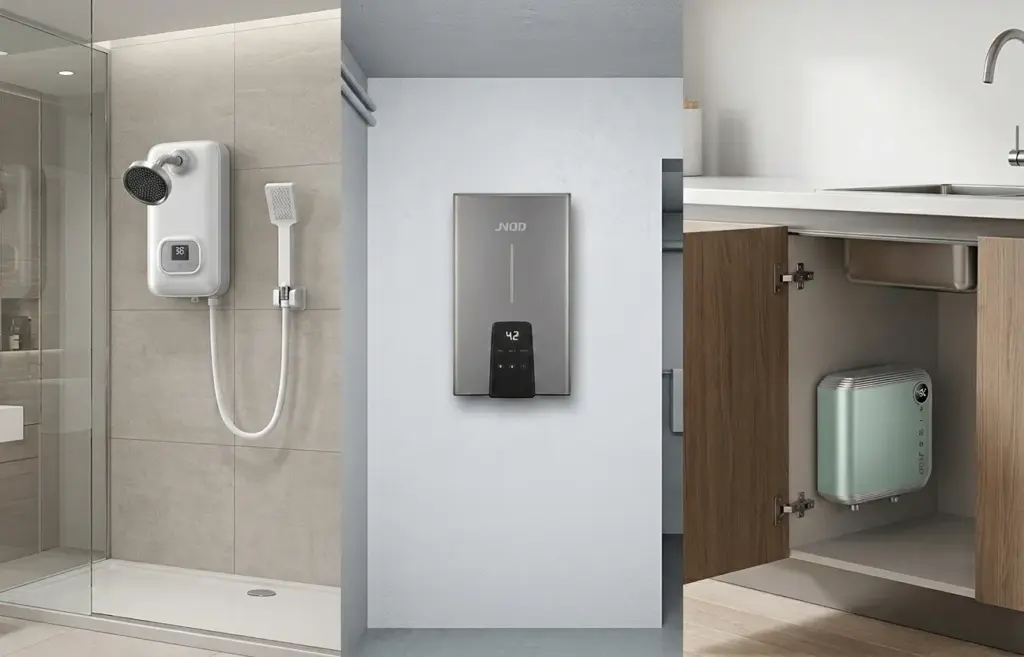
Tankless Water Heaters for Bathrooms & Kitchens
Tankless systems eliminate the traditional storage cylinder. When a hot water outlet is opened, internal flow sensors trigger high-output heating elements that warm the incoming water immediately as it passes through the heating chamber.
Because water is not continuously stored at elevated temperatures, these units eliminate thermal standby loss and free up significant space inside utility closets. However, their primary engineering trade-off is high peak electrical demand. A whole-house system rated at 18kW, for instance, requires a substantial amperage allocation that standard 30-Amp sub-panels cannot support.
In cold climates, low-end tankless units often experience thermal lag when groundwater temperatures drop below 10°C. To address this issue, the JNOD QA-T Instant Tankless Water Heater utilizes variable-frequency power modulation. Instead of running at maximum wattage continuously, the onboard microcontroller adjusts power input dynamically based on real-time flow rate and inlet water temperatures. Data published by the U.S. Department of Energy (DOE) indicates that eliminating standby loss through modulated tankless heating can reduce water heating energy consumption by up to 50%.
Integrated Shower Electric Water Heater for Bathroom
In compact studio apartments or multi-family retrofits, running long runs of insulated hot-water copper piping can be cost-prohibitive.
In these configurations, single-point integrated shower heaters offer a practical alternative. Rather than installing a centralized water heater and routing supply lines through interior walls, the heating unit mounts directly inside the shower zone.
The JNOD QH Smart Instant Electric Shower Heater combines the heating assembly with the shower head rail. Because these units operate inside wet environments, safety engineering is critical. The system incorporates an isolation barrier, IPX4 fluid ingress protection, and real-time earth-leakage detection to meet strict electrical compliance standards.
Point-of-Use Kitchen Heaters
Running long plumbing lines from a centralized utility room to distant kitchen sinks introduces significant thermal loss and water waste.
According to efficiency studies by the U.S. Environmental Protection Agency (EPA), thousands of liters of potable water are flushed down drains annually simply waiting for heated water to travel through long branch piping.
Installing dedicated JNOD Kitchen Water Heaters directly beneath the sink resolves this line-lag. These compact units deliver heated water to the faucet within seconds, reducing line losses and taking unnecessary thermal load off the primary water heating system.
Electric Storage Tank Heaters
Storage tank heaters represent the traditional approach to domestic hot water. They store and continuously heat 150 to 300 liters of water using lower-amperage heating elements.
These systems are best suited for older properties with limited main electrical service (such as 60A or 100A panels) that cannot accommodate the sudden electrical load of a tankless system.
However, their operational limitation lies in recovery time and efficiency. Once the stored hot water volume is exhausted, reheating the tank requires 45 to 90 minutes. Additionally, insulated storage cylinders continuously lose thermal energy to the surrounding ambient air through jacket loss, even when no water is actively being drawn.
Heat Pump Water Heaters
Hybrid heat pump water heaters use a top-mounted refrigeration compressor to extract ambient heat from the surrounding air and transfer it directly into a storage tank.
These systems operate at high efficiency levels, often consuming up to 70% less electrical energy than standard electric resistance tanks. However, field installations require careful site planning:
- They require a minimum unconfined air volume (typically around 20 cubic meters) to operate efficiently.
- They exhaust cold air and generate operational noise, making them suitable for unconditioned garages or large basements, but impractical for tight living spaces.
How Do Different Electric Water Heater Types Compare?
| Application Scenario | Recommended System Type | Primary Technical Consideration |
|---|---|---|
| Modern Apartment / Urban Condo | Tankless Electric (e.g., JNOD QA-T) | Verify main service panel amperage and breaker capacity |
| Bathroom Retrofit / Compact Rental | Integrated Shower Unit (e.g., JNOD QH) | Requires dedicated RCD/GFCI circuit protection |
| Kitchen Sink / Remote Fixture | Under-Sink Point-of-Use | Eliminates line lag, preserves cabinet space |
| Older Home (Low Electrical Service) | Electric Storage Tank | High standby loss, extended recovery time |
| Warm Climate / Large Utility Space | Hybrid Heat Pump | Requires adequate air volume and condensate drainage |
Frequently Asked Questions from Field Engineers
Will a tankless electric water heater overload a residential electrical panel?
It can if the electrical panel is not correctly sized. High-kilowatt tankless units demand high instantaneous amperage. Always evaluate the property’s total electrical load calculation and panel headroom before specifying a whole-house tankless unit.
What causes electric water heaters to lose efficiency over time?
Mineral scale accumulation is the main factor. In hard-water areas, dissolved calcium deposits accumulate on the heating elements. This scale layer acts as thermal insulation, causing the element to operate at higher internal temperatures and leading to early element burnout.
Can integrated electric shower units be installed in standard residential bathrooms?
Yes, provided a dedicated electrical circuit with appropriate RCD/GFCI protection is available. Integrated units like the JNOD QH series eliminate the need for centralized hot water supply lines, making them an efficient choice for fast building retrofits.
Selecting the Right Specification for Your Project
There is no universal solution for electric water heating; system selection depends on floorplan layout, available amperage, and regional water conditions.
When sufficient electrical service is available and space preservation is a priority, tankless systems offer an efficient, continuous supply. Where pipe-run distance or structural retrofitting creates challenges, point-of-use and integrated shower units significantly simplify plumbing infrastructure.
At JNOD, we collaborate with distributors, real estate developers, and OEM partners to configure water heating hardware tailored to local power grid specs and installation demands.
Contact JNOD’s Technical Application Team to review electrical specifications, request product documentation, or receive an OEM quote for your upcoming project.
 English
  Arabic
  Russian
  Spanish