
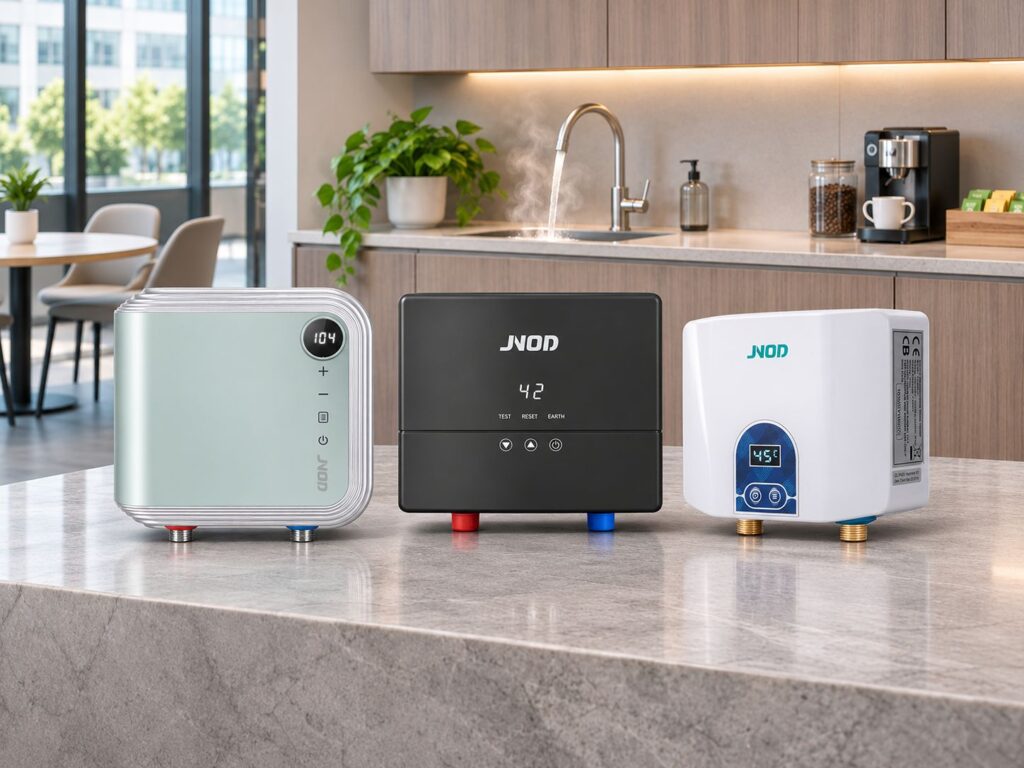
A 120V electric tankless water heater provides hot water directly at the point of use without a bulky storage tank. Its compact design makes it particularly attractive for bathroom basins, commercial handwashing stations, and other low-flow applications.
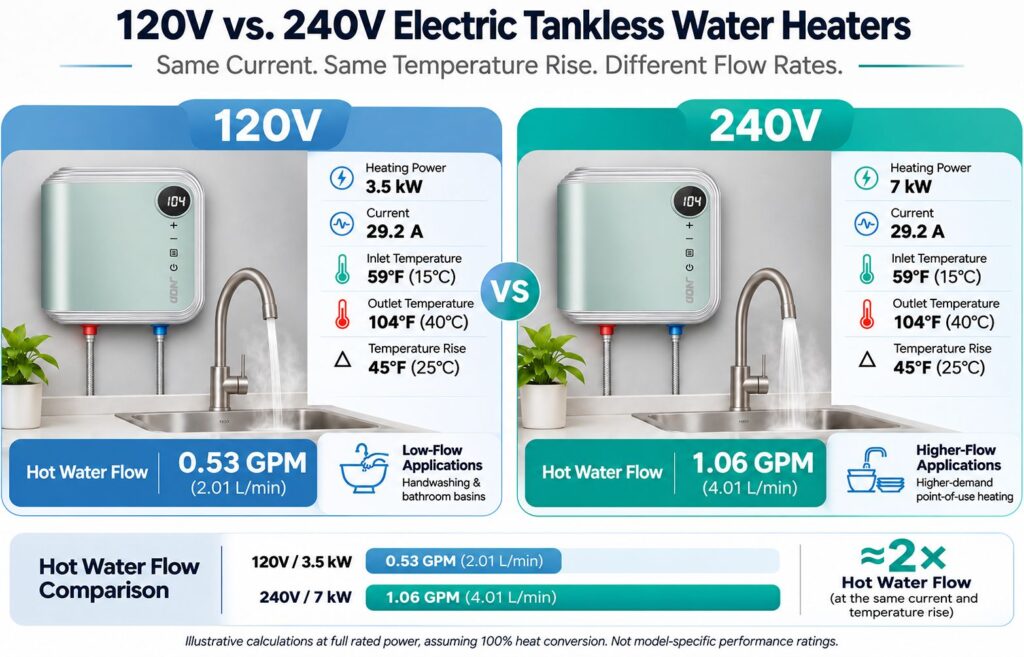
However, a 120V supply does not necessarily mean low electrical demand. A 3.5 kW heater operating at 120V draws about 29.2 amps and can theoretically deliver 0.53 gallons per minute (GPM) at a 45°F (25°C) temperature rise.
For distributors, installers, and project buyers, understanding the relationship between voltage, power, and water flow is essential to selecting the right product.
How Much Hot Water Can a 120V Electric Tankless Water Heater Provide?
Unlike storage heaters, tankless units heat water as it flows through the appliance. Their heating capacity determines how much water they can deliver at the desired temperature.
The basic sizing equation is:
Heating Power (kW) ≈ Flow Rate (L/min) × 0.0698 × Temperature Rise (°C)
The Pacific Northwest National Laboratory’s instantaneous water heater sizing tool provides a useful reference for calculating heating capacity, flow rate, and temperature rise.
Flow Rate Example: A 3.5 kW Tankless Water Heater
Consider a heater operating at full rated power with a target outlet temperature of 104°F (40°C).
| Inlet Water Temperature | Temperature Rise | Flow Rate (L/min) | Flow Rate (GPM) |
|---|---|---|---|
| 41°F (5°C) | 63°F (35°C) | 1.43 | 0.38 |
| 50°F (10°C) | 54°F (30°C) | 1.67 | 0.44 |
| 59°F (15°C) | 45°F (25°C) | 2.01 | 0.53 |
| 68°F (20°C) | 36°F (20°C) | 2.51 | 0.66 |
Calculated theoretical values assume 100% heat conversion at full rated power. Actual flow performance may be lower.
The table shows a key seasonal difference. At an inlet temperature of 68°F (20°C), the heater can theoretically supply 0.66 GPM. When the incoming water drops to 41°F (5°C), the available flow falls to approximately 0.38 GPM.
For North American distributors, winter inlet water temperature is therefore a valuable starting point for product selection.
Our instant electric water heater power selection guide provides additional sizing examples for higher-demand applications.
Can a 120V Tankless Water Heater Use a Standard Outlet?
A 120V rating does not automatically make a tankless water heater a plug-and-play appliance. High-powered heating elements can draw considerably more current than common household devices.
For a resistive heating load:
Current (A) ≈ Power (W) ÷ Voltage (V)
| Rated Power | Supply Voltage | Approximate Current |
|---|---|---|
| 1.5 kW | 120V | 12.5 A |
| 1.8 kW | 120V | 15.0 A |
| 2.4 kW | 120V | 20.0 A |
| 3.0 kW | 120V | 25.0 A |
| 3.5 kW | 120V | 29.2 A |
A 3.5 kW heater exceeds the capacity of ordinary 15A and 20A outlets. It requires a suitably rated electrical circuit and an approved connection method.
These figures illustrate operating current, not recommended circuit-breaker sizes. A qualified electrician must determine the appropriate wiring, circuit protection, grounding, and connection method.
For product buyers, rated current is just as important as rated voltage.
Best Applications for 120V Tankless Water Heaters
Compact 120V models are particularly useful where hot water demand is modest and installation space is limited. Placing the heater close to the outlet also reduces unnecessary hot water pipe runs.
Commercial Handwashing Stations
Public restroom faucets provide a practical example of low-flow water heating.
The U.S. Environmental Protection Agency’s WaterSense guidance on bathroom faucets identifies 0.5 GPM (approximately 1.9 L/min) or less as an efficient flow rate for public lavatory faucets.
At 0.5 GPM, a 3.5 kW heater can theoretically raise the water temperature by approximately 48°F (26.5°C).
With incoming water at 59°F (15°C), the calculated outlet temperature reaches approximately 107°F (41.5°C). This illustrates the potential of compact tankless heaters for low-flow handwashing.
Office Kitchenettes and Breakrooms
A point-of-use heater provides warm water for handwashing, rinsing cups, and light cleaning. Its tankless operation is particularly useful in offices where hot water demand is intermittent throughout the day.
Hotels and Guest-Room Basins
Individual heaters offer an alternative to extending central hot water pipes to distant basins and staff facilities. For guest-room basins with higher-flow faucets, additional heating power may be more practical.
| Application | 3.5 kW Tankless Heater Suitability |
|---|---|
| Low-flow public handwashing station | Suitable at adequate inlet temperatures |
| Bathroom basin | Suitable for modest hot water demand |
| Office kitchenette | Light washing and intermittent use |
| Guest-room basin | Suitable for selected low-flow installations |
| High-flow kitchen faucet | Higher heating power is preferable |
| Conventional shower | Generally insufficient |
| Multiple simultaneous outlets | Larger or separate heaters are preferable |
For projects with limited cabinet space, see our under-sink water heater guide for additional information on compact installation layouts.
120V vs. 240V Electric Tankless Water Heaters
A 240V electrical supply allows a heater to deliver more heating power at the same operating current.
Consider the following theoretical configurations:
| Comparison | 120V Heater | 240V Heater |
|---|---|---|
| Rated Power | 3.5 kW | 7 kW |
| Approximate Current | 29.2 A | 29.2 A |
| Flow at 45°F (25°C) Temperature Rise | 2.01 L/min | 4.01 L/min |
| Equivalent Flow | 0.53 GPM | 1.06 GPM |
Illustrative electrical and thermal calculations, not model-specific performance ratings.
At approximately the same current, the 240V heater provides twice the heating power and theoretical hot water capacity.
Consequently, 240V equipment offers greater flexibility for higher-flow outlets and colder incoming water.
Does 120V Consume Less Electricity Than 240V?
Lower voltage does not automatically mean lower energy consumption.
Heating 10 liters of water by 25°C requires approximately 0.29 kWh of thermal energy, regardless of the supply voltage.
A higher-powered heater delivers that energy more quickly. For equivalent water consumption and temperature rise, heating efficiency and system losses influence electricity usage more directly than voltage alone.
Both voltage configurations have their place in a well-planned electric water heater portfolio.
JNOD 120V Electric Tankless Water Heater Options
JNOD develops compact electric water heaters with multiple voltage and power configurations for international markets. The KFU, KJ, and KH-A series combine on-demand heating with electronic temperature regulation and space-saving designs.
| Product Series | Rated Voltage Options | Series Power Options | Key Features |
|---|---|---|---|
| KFU | 110–120V / 220–240V | 3.5 / 6.5 / 7 kW | Touch controls, stepless adjustment knob, optional Wi-Fi |
| KJ | 110–120V / 220–240V | 3.5 / 4.5 / 5.5 / 6 kW | Reversible display, optional Wi-Fi, earth detection |
| KH-A | 110–120V / 220–240V | 3.5 / 5 / 6 kW | Compact housing, touch controls, reversible display |
Power options represent the complete product series rather than all available combinations at each voltage.
Patented Cast-Aluminum Heating Technology
At the heart of the KFU, KJ, and KH-A series is JNOD’s patented cast-aluminum heating technology, combining a cast-aluminum heating body with stainless steel water channels.
The aluminum body distributes heat across the heating assembly, while the stainless steel channels carry water separately from the electrical heating components.
This design promotes uniform heat transfer, helps reduce localized overheating, and improves resistance to limescale buildup.
With a published thermal efficiency of 98%, JNOD’s heating technology delivers efficient on-demand water heating without the standby heat losses associated with a storage tank.
Intelligent Temperature Control
Electronic controls allow users to adjust water temperature directly. The KFU offers a temperature setting range of 86–131°F (30–55°C) and automatic thermostatic regulation with a published precision of ±1°C.
Optional Wi-Fi connectivity adds convenient remote temperature adjustment and on/off control.
Compact Design and Integrated Protection
Measuring just 225 × 205 × 80 mm, the KFU offers a space-saving solution for point-of-use installations.
Its integrated safety features include overheat, overpressure, anti-scalding, and electrical leakage protection. In addition, automatic fault detection displays error information to assist troubleshooting.
The KJ series also features earth detection and earth-leakage circuit breaker (ELCB) functionality, adding further electrical protection.
What Should You Look for in a 120V Tankless Water Heater?
For North American importers and distributors, successful product selection starts with the electrical infrastructure and hot water requirements of the target market.
| Purchasing Factor | Selection Priority |
|---|---|
| Voltage and Frequency | Electrical supply in the destination market |
| Rated Power and Current | Available circuit capacity |
| Flow Performance | Hot water delivery at winter inlet temperatures |
| Minimum Activation Flow | Compatibility with low-flow and sensor-operated faucets |
| Water Connections | Thread types and regional plumbing compatibility |
| Market Compliance | Model-specific electrical safety certification and documentation |
| Product Customization | Branding, housing, controls, and packaging |
| After-Sales Support | Service documentation and spare parts availability |
Offering compact 120V products alongside higher-powered 240V alternatives gives distributors greater flexibility across residential and light commercial applications.
With in-house R&D, manufacturing, and OEM/ODM capabilities, JNOD supports product development and supply programs for international partners.
FAQ
A typical 3.5 kW model generally cannot meet conventional shower requirements. For example, heating 1.5 GPM of water by 45°F (25°C) requires approximately 9.9 kW of thermal power.
Compact 120V models are better suited to low-flow sinks and handwashing stations.
No storage tank needs to recover between uses. The heater continues producing hot water while water flows, within its rated heating capacity.
These terms are often used interchangeably in product searches. JNOD offers compact water heater series with published 110–120V ratings for the relevant electrical markets.
Yes, provided the faucet delivers enough water to activate the heater. Matching the minimum activation flow to the faucet’s output is particularly important in commercial restrooms.
Conclusion
A 120V electric tankless water heater offers compact, on-demand heating for low-flow applications, while 240V alternatives provide greater flexibility for higher hot water demand.
JNOD combines patented cast-aluminum heating technology, intelligent temperature control, multiple voltage configurations, and OEM/ODM manufacturing capabilities to support international electric water heater portfolios.
Looking for a Reliable Electric Tankless Water Heater Manufacturer?
Contact JNOD to explore product configurations, wholesale supply, and customized electric water heating solutions for your market.
 English
 Arabic
 Russian
 Spanish